

The benefits of IT staff augmentation go far beyond “faster hiring”. For growing product development teams, it’s a strategic way to fill talent gaps, add specialized skills as needed, and protect the focus of the core team. Without tying the business to long and expensive internal hiring cycles.
The pressure is real. According to McKinsey’s Tech Talent Roundtable, only 16% of executives feel confident in the technology talent they have available to drive their digital transformation, and the 2024 Deloitte Global Outsourcing Survey shows that 80% of executives now plan to maintain or increase investment in third-party talent, driven less by cost and more by access to skills and agility.
Roadmaps rarely wait for the hiring process to be completed. When there is a shortage of skilled employees, teams either slow down their work or redistribute tasks, distracting internal staff from product development. Augmenting IT staff is designed for precisely such situations. Project-based hiring that allows you to quickly increase capacity while maintaining control over task execution within the organization.
What is IT staff augmentation?
A hiring model where you add external technical specialists to your core team for a limited time: to fill staffing gaps, gain specialized skills, or accelerate delivery without committing to full-time hires.
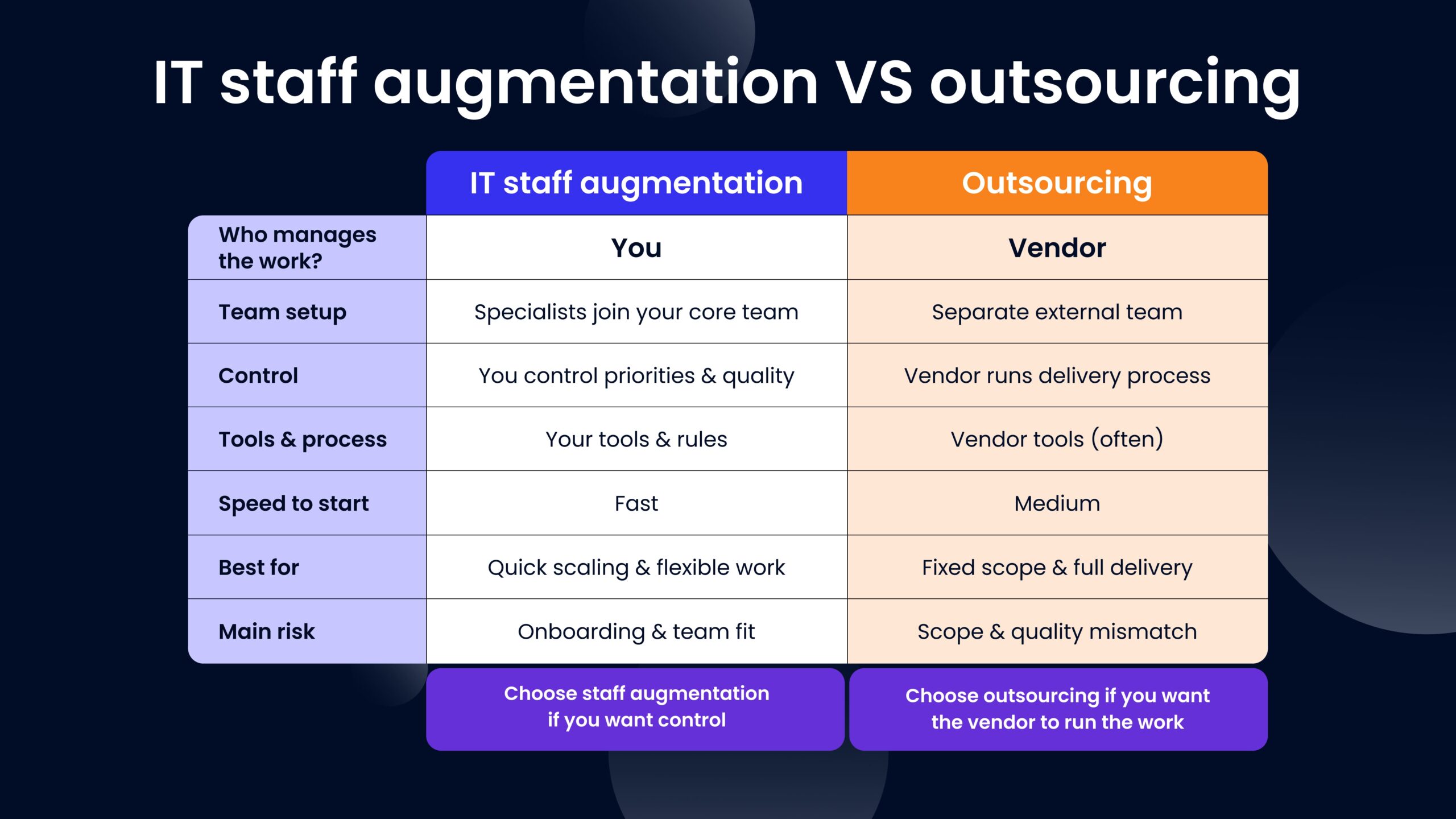
Unlike outsourcing, staffing augmentation does not transfer ownership to the vendor. Your company retains control over the product and the work. Your team sets priorities, manages tasks, and approves results. Specialists work alongside your internal employees, inside your daily workflow (stand-ups, sprint planning, code reviews, releases) rather than in a separate “vendor team”.
Engagements are typically scoped for 3-6 months around a release, migration, or new feature, then extended, scaled, or wound down based on the roadmap
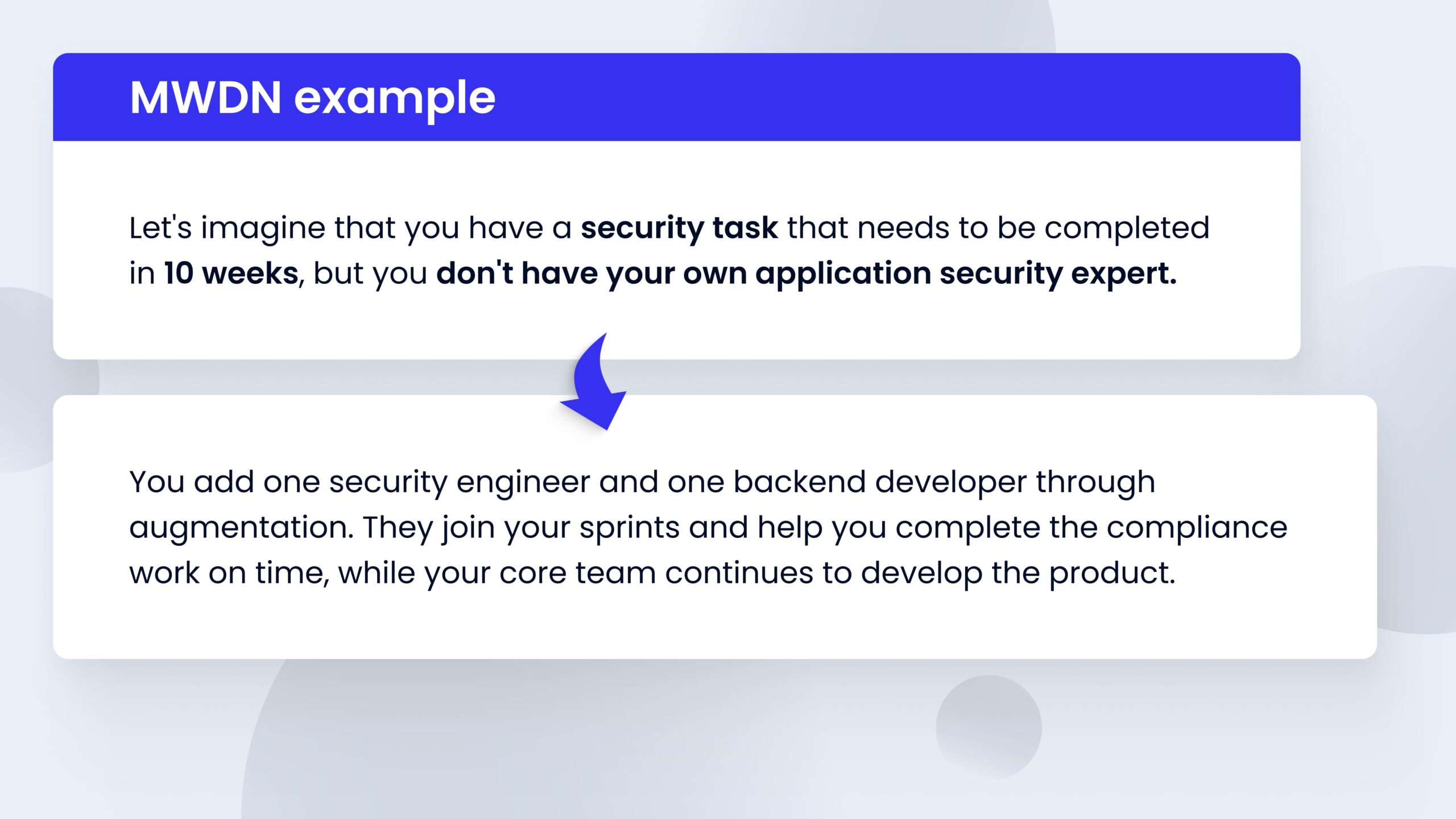
Benefits of IT staff augmentation: access to global talent
One of the biggest benefits of IT staff augmentation is access to a larger talent pool. You’re not limited to one city or country – useful when local hiring markets are tight or when you need a niche specialist quickly. For context, the average time to fill a tech role in the US in 2024 was around 44 days, and senior software roles often take 3-4 months. Augmented engineers, by comparison, typically join in 5-10 business days.Augmentation is especially useful for stage-specific skills: DevOps/SRE, QA automation, data engineering, cloud security, AI/ML, mobile, or legacy modernization. Instead of pausing the roadmap to recruit, you add the role and keep the core team focused.
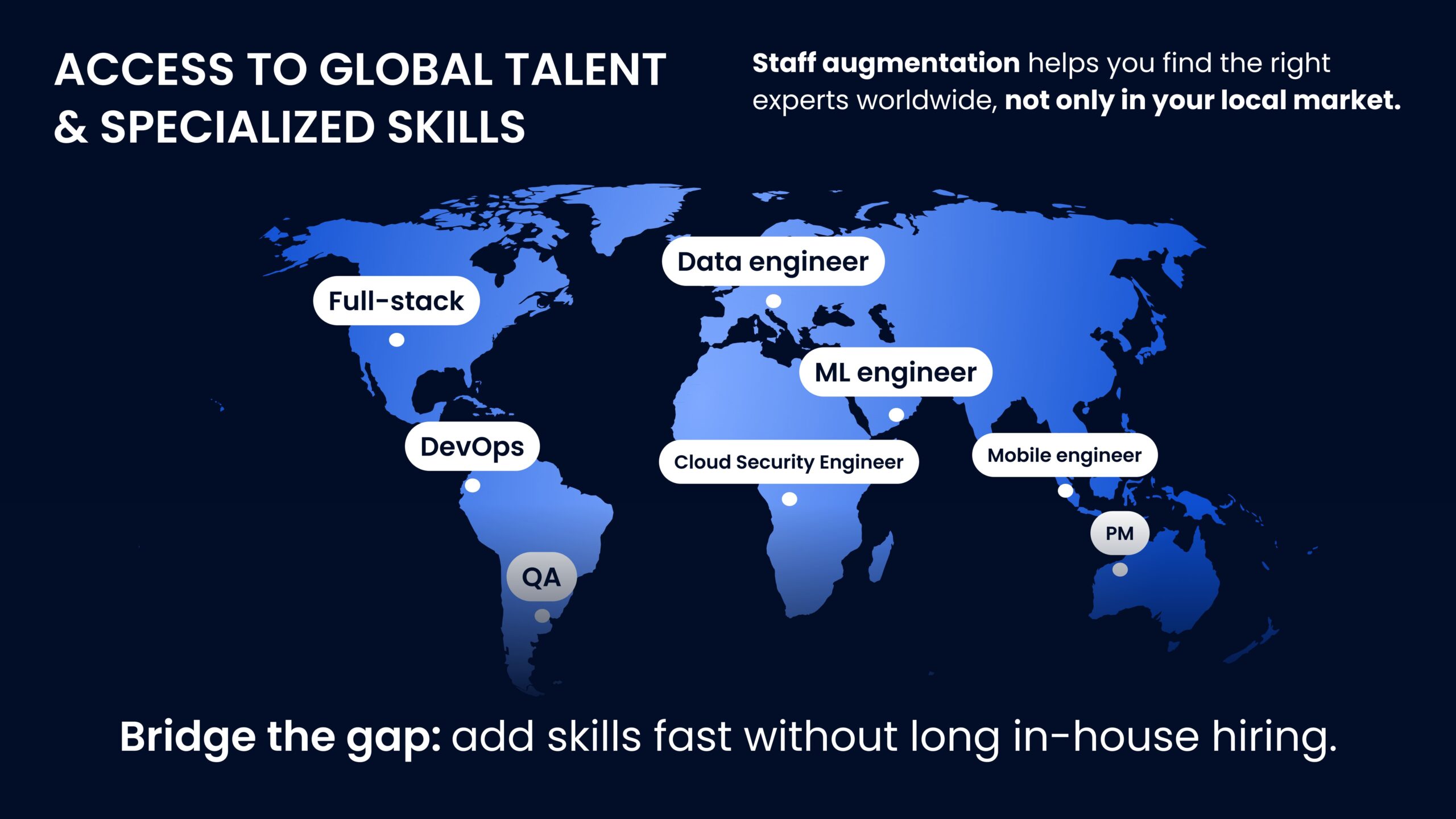
Check 3 things to evaluate the fit:
✔️ Timezone overlap
You need shared hours for daily work and quick decisions.
✔️ Communication
Clear updates, good questions, and early warning of risks.
✔️ Industry experience
It’s a bonus if they know your industry (fintech, healthcare, B2B SaaS) and its rules.
When these criteria match, the new specialist integrates faster and work remains uninterrupted.
Cost-efficiency through lower overhead
The cost-effectiveness of IT staff augmentation is not just about hourly rates. Greater savings are often achieved through reduced overhead costs. You spend less time on hiring: fewer interviews, fewer approvals, and less internal administrative work. Your core team can focus on getting stuff done instead of constantly recruiting.
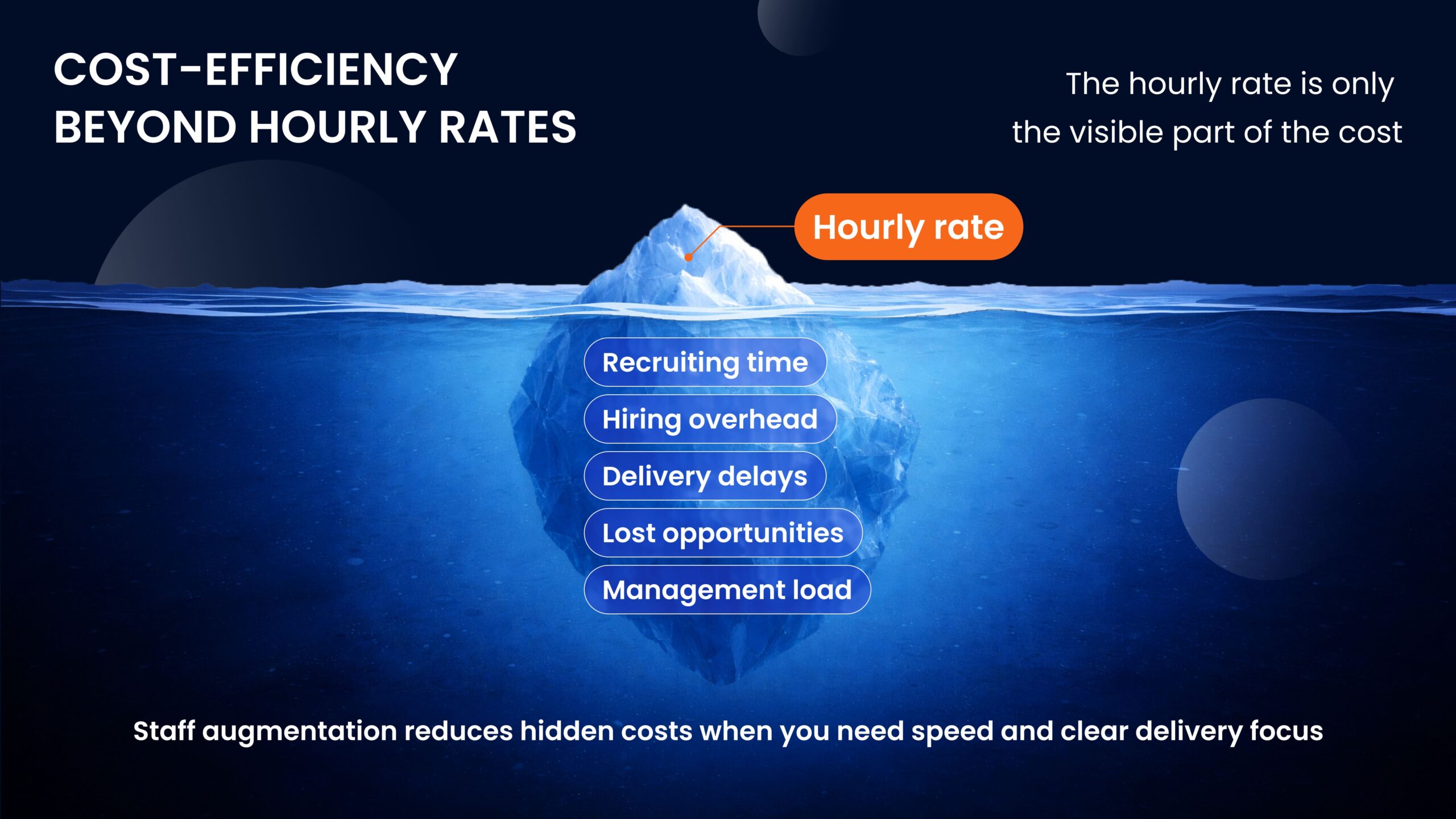
Delays cost money too. The Society for Human Resource Management estimates the cost of a single bad hire at 50-200% of the role’s annual salary, and a 2025 McKinsey analysis cited by mid-market tech companies links each unfilled senior engineering seat to measurable revenue impact. Adding capacity faster keeps releases on schedule.
But it’s not always cheaper. For stable, long-term core roles, full-time hiring usually wins on total cost of ownership. Augmentation is most cost-effective for project-based pushes, niche skills, or when in-house hiring would take more than 4-6 weeks.
Scalability, flexibility, and faster time-to-hire
Product roadmaps often have peaks: launches, migrations, compliance deadlines, and partner integrations. At these moments, you need more delivery power, but you don’t want to constantly expand your organizational structure. IT staff augmentation gives you an easy way to scale up and down based on actual workload.
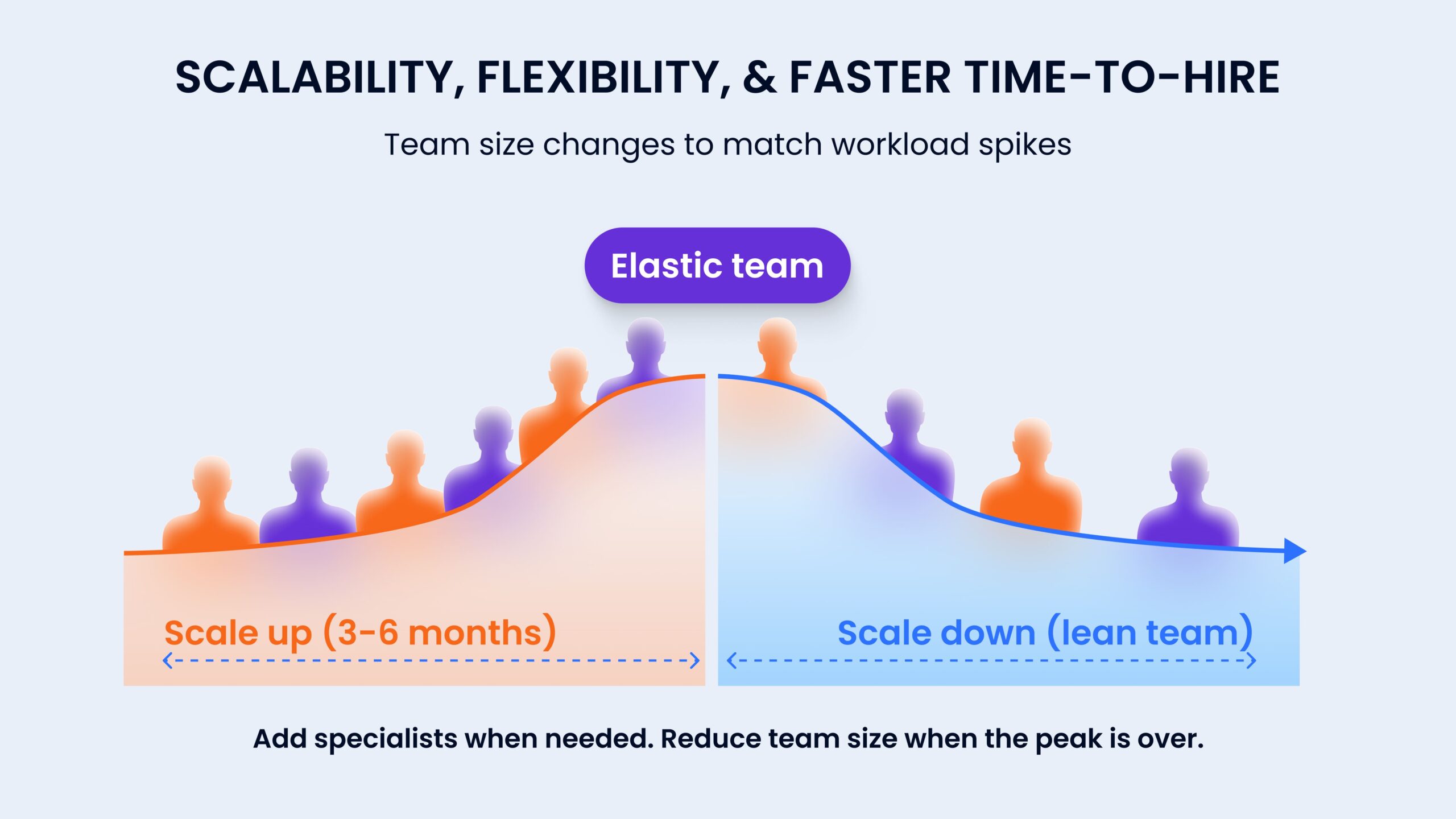
Many teams use staff augmentation because it is easy to scale. You can increase your team for 3-6 months for a launch or migration, and then return to a lean structure. You also add people only where they are needed. For example, you can bring in 1 DevOps + 2 backend + 1 QA without reorganizing the entire team. If the workload changes, you can quickly adapt by adding or reducing capacity, instead of starting the hiring process from scratch.
Another advantage is speed. But it only works with clean onboarding. The 2024 Accelerate State of DevOps Report by Google’s DORA team found that stable priorities, well-defined responsibilities, and clear team boundaries are among the strongest predictors of software delivery performance. Augmented engineers don’t change that math, they amplify it in either direction
“Augmentation only delivers when both sides align early: on goals, responsibilities, access to tools, definition of done, and a clear communication rhythm. Skip that and you’re paying for capacity you can’t actually use. Get it right and faster hiring becomes faster delivery.”
— Mykhaylo Merkulov, COO, MWDN
IT staff augmentation vs managed services
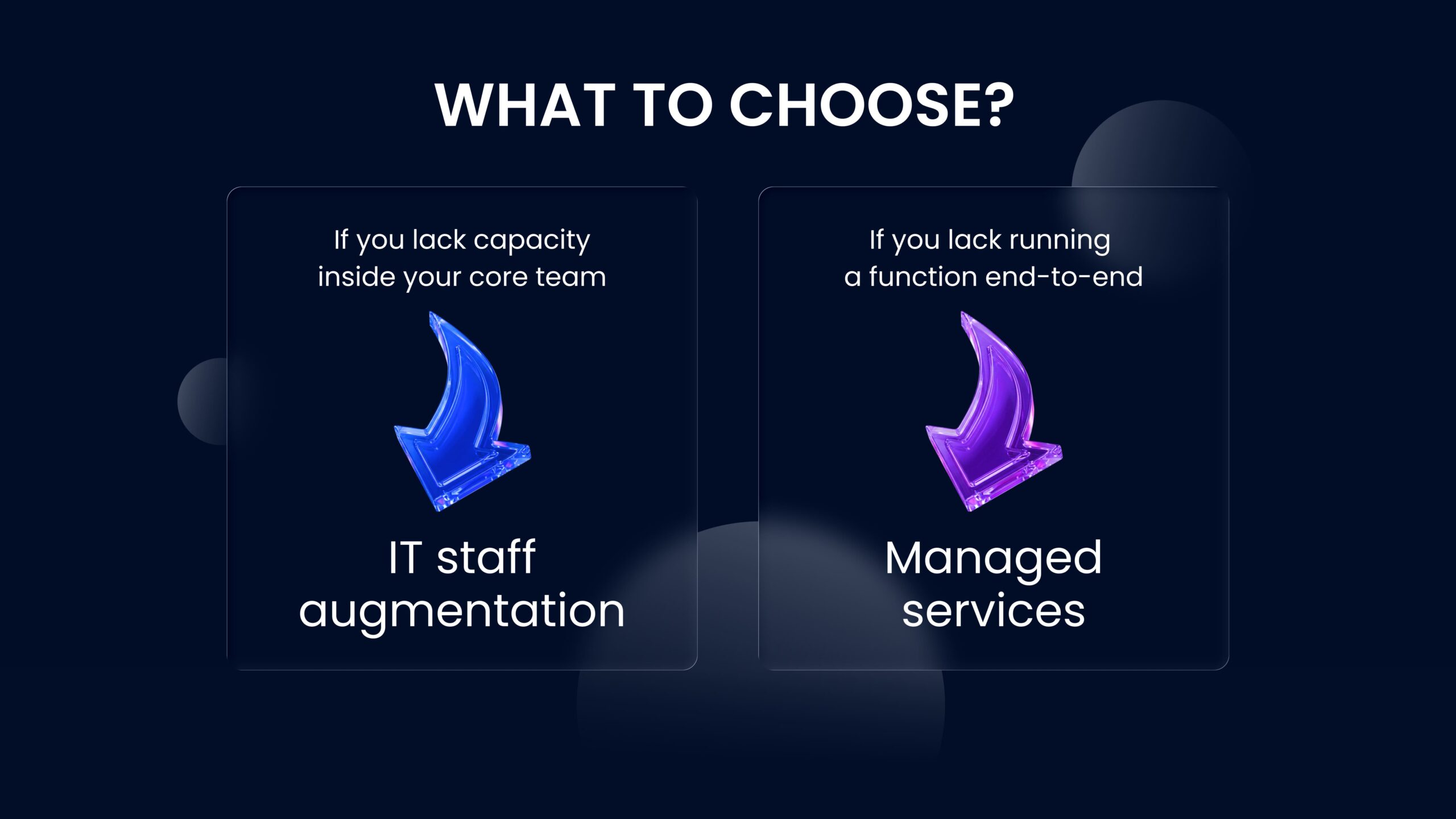
These two models solve different problems.
IT staff augmentation
With it you add specialists to your existing team. They work within your processes and tools. You retain control over priorities, execution, and quality. This option is best when you need additional resources, close collaboration, and clear accountability from your internal product and engineering leaders.
Managed services
Help you transfer the entire function or outcome to the provider. Examples include infrastructure management, application support, SOC/security monitoring, or QA as a service. The provider manages day-to-day operations and is responsible for service levels and outcomes.
For broader context, here’s how the related models compare:
| Model | When it fits |
|---|---|
| Outsourcing | Defined scope handed to a vendor with limited day-to-day integration. |
| Dedicated team | Stable external team operating as a separate unit, long-term. |
| Internal hiring | Long-term core roles where stability outweighs slower time-to-fill and higher overhead. |
Summary
The benefits of IT staff augmentation go beyond faster hiring. This model helps you fill staffing gaps, add specialized skills, and keep your core team focused. You also maintain control over priorities, execution, and quality, as specialists work within your team and follow your processes.
Staff augmentation is especially useful when you need to scale quickly, work in a skilled labor shortage, or avoid delays that slow revenue growth and development. It can also reduce hidden costs such as recruitment time, hiring overhead, and the cost of missed deadlines.
Staff augmentation is a scaling tool, not just a hiring shortcut. It helps you fill skill gaps, ride delivery peaks, and keep the core team focused, while leaving priorities, architecture, and quality fully in your hands. It works best when you treat it as an integration system: clear ownership, defined scope, structured onboarding, and overlapping working hours.
Ready to add capacity? Tell us which roles are blocking your roadmap. We’ll come back within 48 hours with a vetted shortlist and a clear engagement plan.
FAQ
How do I protect IP and data security when augmented specialists join our team?
MWDN can help set this up from day one. We align security requirements, access levels, and working rules before the specialist starts, so you stay protected while delivery continues.
How can I keep code quality and engineering standards consistent with augmented engineers?
MWDN can help match specialists who fit your stack and your engineering culture. We also support a clean start with shared rules and fast feedback loops, so quality stays predictable.
How do I measure success with IT staff augmentation?
MWDN can help define simple success metrics that match your goals. We check progress during the engagement and help adjust early if speed, fit, or communication needs improvement.
What happens if the specialist is not a good fit?
MWDN can help with a structured feedback and replacement flow. If fit is not right, we propose alternatives quickly and support the transition, so the project keeps moving.
What should I prepare for onboarding to get results faster?
MWDN can help you create a simple onboarding checklist and a first-week plan. We align roles, responsibilities, and definition of done early, so “fast hiring” becomes real delivery.