
If you are looking for IT staff augmentation services, you are probably facing a simple problem: your roadmap is moving faster than your ability to hire. Maybe you need a DevOps specialist for your infrastructure, QA engineers to stabilize releases, or developers who can ramp on your stack without months of onboarding.
You’re not alone. According to the 2024 Deloitte Global Outsourcing Survey, 80% of executives plan to maintain or increase investment in third-party talent, driven less by cost and more by access to skills and agility. And McKinsey’s Tech Talent Roundtable reports that only 16% of executives feel confident in the tech talent they have available to drive their digital transformation.
At MWDN, we help product teams scale by augmenting their IT staff. We add proven engineers to your internal team so you can move faster, maintain consistent quality, and retain complete control over your delivery.
Why teams choose MWDN
We help teams that need extra senior capacity but can’t afford the time and risk of full-time hiring cycles. Engineers we provide integrate into your team and your workflow, not the other way around.
| Step | What happens |
|---|---|
| 1. Discovery & role definition | We agree on outcomes, scope, “definition of done,” and how the role fits your team. |
| 2. Vetted shortlist | You receive candidates pre-checked for technical depth and remote communication. |
| 3. Structured onboarding | Access, environments, docs, sprint cadence, and success criteria are ready before week 1. |
| 4. Workflow integration | Engineers join your standups, planning, code reviews, and release cycle. |
| 5. Continuity & adjustment | Regular feedback, scope flex, and replacement options are available if priorities shift. |
Our 5-step engagement process
| What to do | Why it matters |
|---|---|
| Show real project details | Explain what you built, what your role was, and what changed because of your work. |
| Keep your CV simple | Clear responsibilities and results work better than broad, polished phrases. |
| Be honest about AI experience | Say where you used AI, why, and what changed in your workflow. |
| Prepare to discuss your work live | Real experience is easier to explain without scripts or perfect wording. |
| Avoid inflated language | Hiring teams notice when a profile sounds bigger than the actual experience. |
Top 4 benefits of staff augmentation
When you need to scale without losing control, this model gives you four concrete advantages:
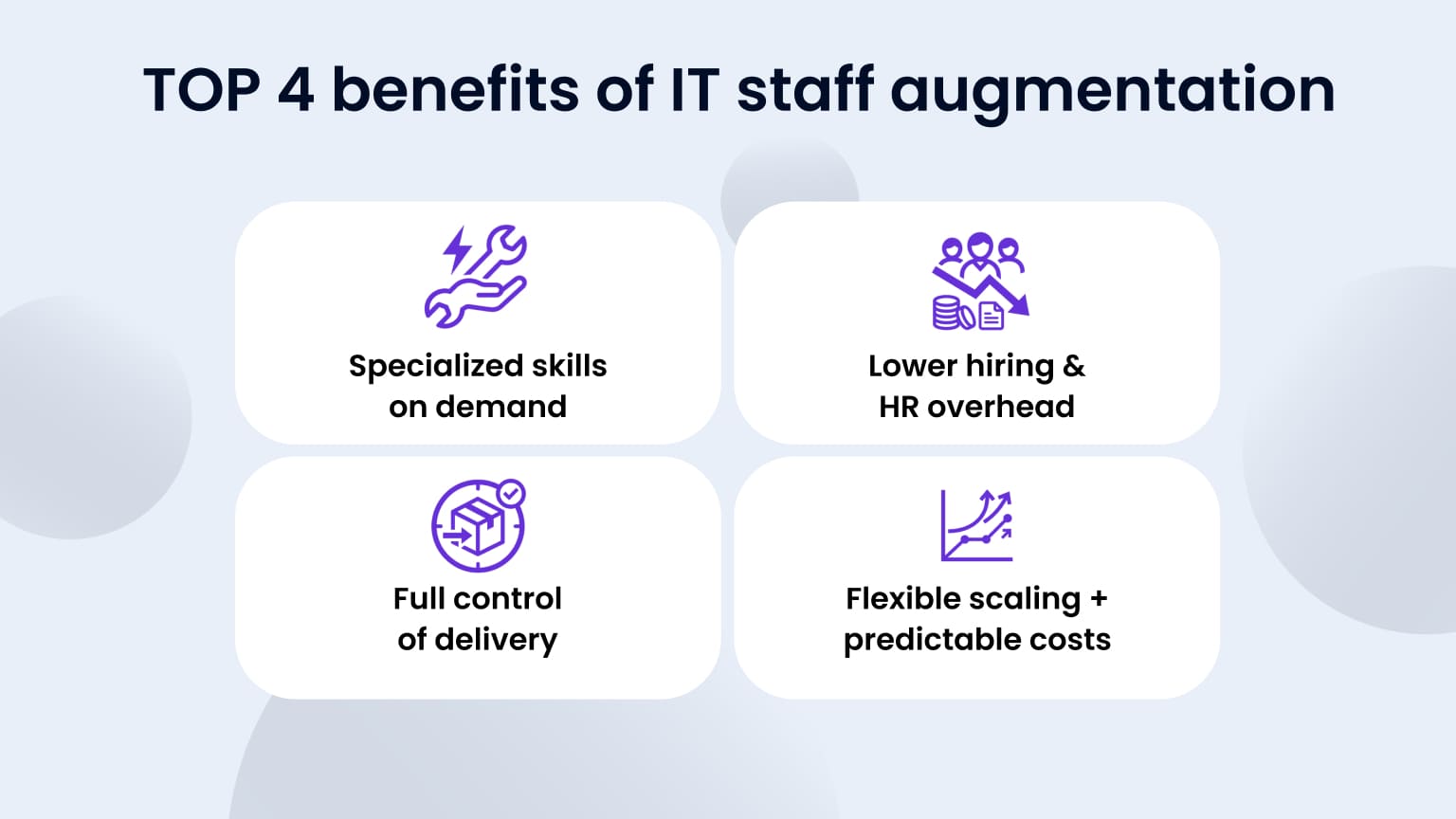
1. Access to specialized skills, on demand
DevOps, security, cloud, data, QA automation: niche skills are the slowest to fill internally. The average time to fill a tech role hit ~44 days in 2024, and senior software roles often take 3-4 months (Mind IT Systems, 2026). Augmentation closes the gap in days, not quarters.
2. Reduced HR load and fewer hiring “hidden costs”
Full-time employment is not just about salary. It also involves hiring cycles, time spent selecting candidates, contracts, payroll taxes, legal compliance, and ongoing administrative work. Increasing your staff reduces hiring costs and administrative burdens. This allows your team to focus on product development rather than hiring.
3. Full control over execution and standards
Your augmented specialists work within your workflow. You retain control over priorities, architectural decisions, code review policies, readiness definitions, release frequency, and tools. These are additional capabilities. Without transferring product management to an external vendor.
4. Predictable scaling and stronger ROI
When priorities change, it becomes difficult to reduce staff. Increasing your workforce gives you flexibility: you can increase the number of employees during a busy quarter, stabilize production, and then adjust your workforce when demand changes. This allows you to control overhead costs and protects your return on investment, as you only pay for the capacity you actually need.
When does your company IT staff augmentation?
Most teams reach this decision when one of these patterns hits:
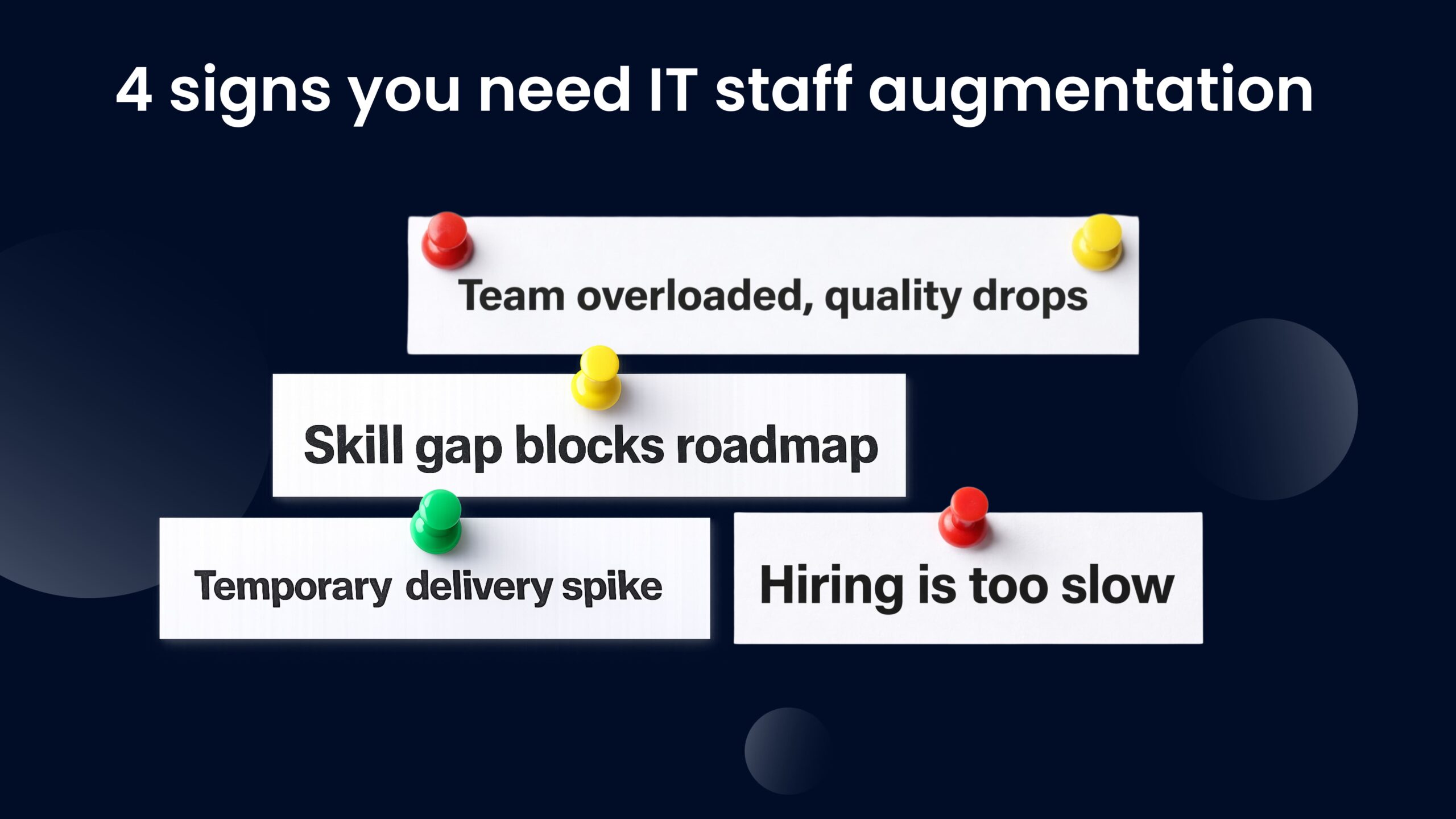
1. Your roadmap is blocked by a missing skill set
You are moving forward, but one gap is slowing down the entire process (DevOps, security, quality control automation, data, cloud, or a specific structure). Adding a specialist speeds up the delivery process faster than trying to “redistribute” work among already busy colleagues.
2. Hiring is too slow and time-to-market is at risk
62% of IT leaders report a lack of qualified personnel, and senior tech roles can take 3-4 months to fill. Augmented engineers typically join in 5-10 business days.
3. You need temporary capacity for a specific push
Release cycles, migration, performance improvements, compliance deadlines, growth spikes. This often requires additional resources for a certain period. Expansion allows you to scale for peak loads without constantly increasing your payroll.
4. Your core team is overloaded and quality is slipping
When senior engineers are constantly interrupted, quality suffers, reviews are rushed, testing is ignored, incidents increase, and ultimately delivery slows down even more. Scaling up can help balance the system so your team can get back to building, not reacting.
“Augmentation only works when it’s treated as an integration system, not as ‘throwing people at a problem.’ The teams that get value out of it are the ones with clear ownership, a written definition of done, and overlapping working hours. The people side and the process side both need to be in place from day one.”
— Vitalii Vystavnyi, Managing Partner, MWDNIncreasing staff numbers does not solve the problem of unclear product responsibility or broken delivery procedures. It can be ineffective if viewed as “throwing people at the problem”. The usual reasons for failure are predictable: poor induction, unclear responsibilities, poor documentation, and chaotic collaboration across time zones. That is why MWDN emphasizes structured onboarding, clear role allocation, overlapping working hours, and communication protocols. This way, additional engineers do not create an additional coordination burden.
Roles we staff
Most client requests fall into three core categories tied directly to delivery speed and quality:
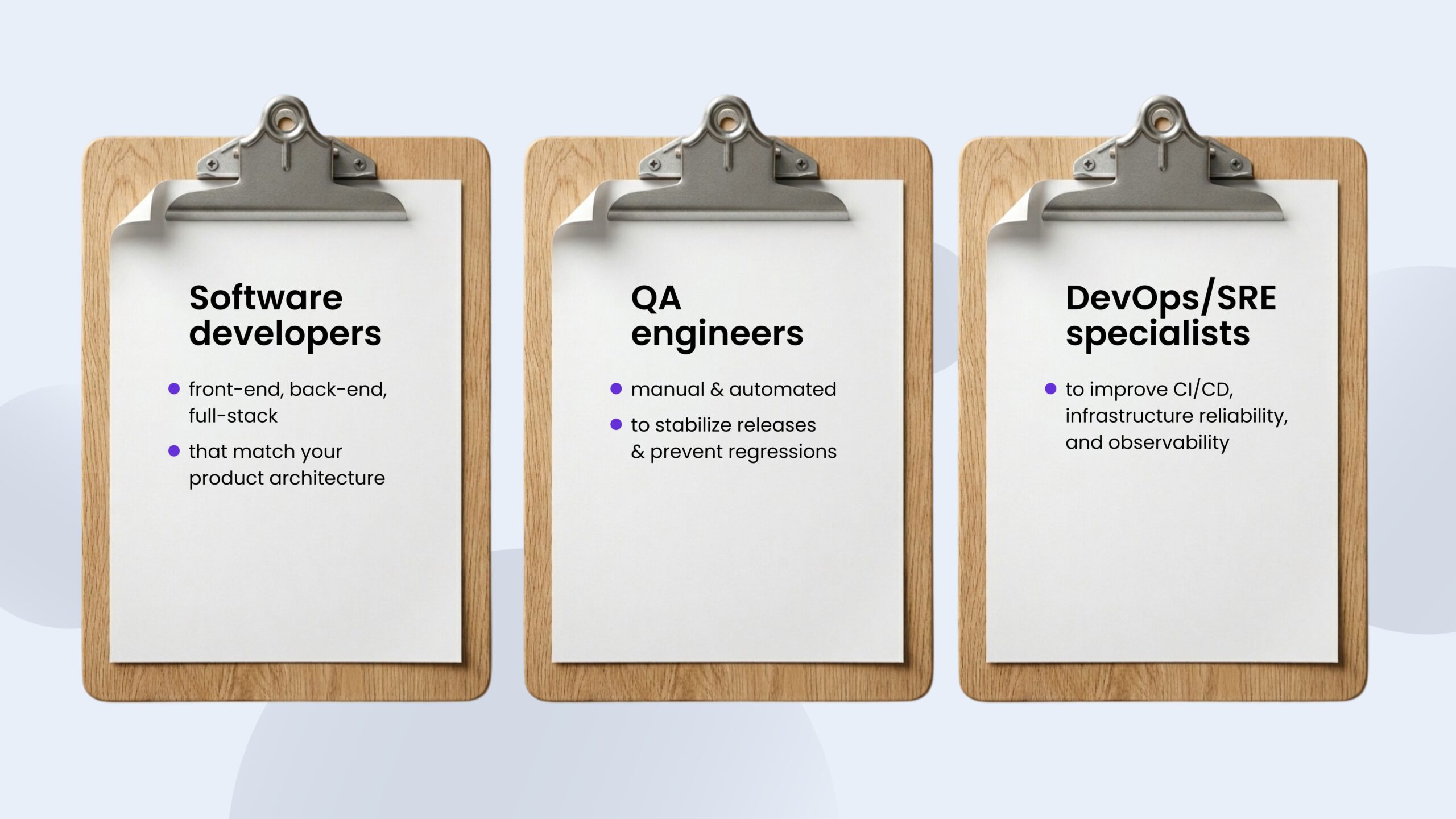
These are the “core” roles that teams use to quickly increase throughput, without changing how they manage or deliver their product.
Beyond the core three, we also staff:
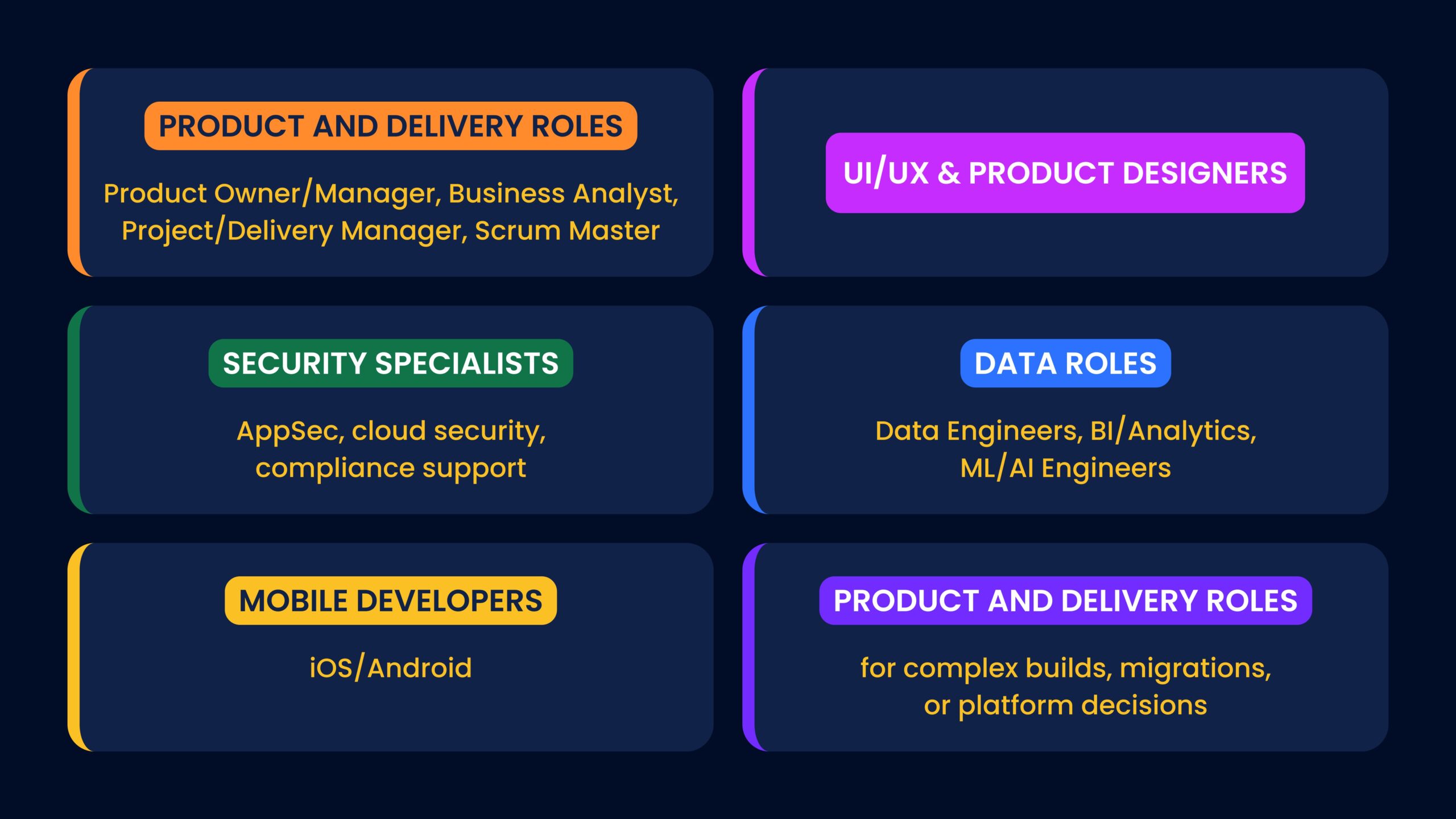
Summary
IT staff augmentation can be done more efficiently by increasing IT staff, as the team is under pressure to complete tasks and hiring full-time employees is an operational burden in terms of time and effort. Instead of putting your hiring plans on hold, you can integrate skilled professionals into your team to increase its capacity while maintaining control over priorities, architecture, and release quality.
MWDN ensures the effectiveness of this model by treating staff expansion as an integration system. This means clearly defining roles, carefully selecting candidates based on actual experience with the stack, structured onboarding that prevents “floating,” overlapping time zones for faster decision-making, and clear communication procedures that ensure transparency of progress. When done right, scaling down reduces overhead recruitment costs and hidden HR management costs, improves cost predictability, and helps protect your return on investment. After all, you only pay for the resources you really need.
Ready to scale your team?
Tell us what you’re building and which roles are blocking your roadmap. We’ll come back within 48 hours with a shortlist of pre-vetted candidates and a clear engagement plan.
FAQ
How quickly will I see results after I start IT staff augmentation services?
A typical timeline depends on the complexity of the role, readiness to adapt (access, repository, environment), and speed of decision-making. Teams usually see the fastest results when the scope of work is clear and the results are measurable (feature delivery, test coverage, CI/CD improvements, incident reduction). To speed up this process, it is helpful to prepare a short “starter pack”: priorities for the first 1-2 weeks, key contacts, links to documentation, and release expectations.
MWDN’s goal is to reduce the time to results by aligning expectations on day one and immediately integrating specialists into your workflow. You get a clear plan for getting started, overlapping working hours where necessary, and a predictable communication rhythm, making progress visible early on.
What if the engineer is not a fit, can we change course quickly?
Recruitment challenges exist in any hiring model, so the goal is to identify them early and correct them quickly. Define simple success criteria for the first 10-14 working days: communication habits, task completion speed, quality expectations, accountability, and collaboration rhythm. If something is wrong, it is better to fix it early on than to incur costs for months.
MWDN helps reduce the risk of mismatch with proven candidate lists and structured checkpoints during onboarding. If priorities change or mismatches remain, we help you make quick adjustments. No need to completely restart your team.
How do you handle IP protection, security, and confidentiality?
Security usually comes down to practical controls, not promises. Use role-based access and least privilege, separate environments where necessary, and rely on audit logs for accountability. For sensitive products, phased access works well: start with limited scope and expand privileges only after performance and trust have been proven.
MWDN works within your security policies and tools, not around them. We agree on access rules and data handling expectations before we start working together to ensure that the collaboration remains compliant from the outset.
How should I think about pricing and ROI in staff augmentation?
The easiest way to estimate ROI is to compare the total cost of “doing the work internally” with the cost of adding capacity now. Internal costs include time spent on recruitment, management time spent on interviews and onboarding new employees, payroll taxes/overhead, and opportunity costs associated with delayed production. Increasing headcount typically replaces a significant portion of recruitment and administrative costs with predictable monthly capacity costs.
MWDN allows you to measure ROI by helping teams identify results early on and track their progress. This way, you don’t pay for “hours.” You pay for real progress related to your action plan.
Will this create extra management work for my leads?
Maybe. If the rules of ownership and operation are unclear. The best precaution is a light structure: one owner for priorities, a written definition of “done,” a documented context, and a fixed update rhythm (daily asynchronous + weekly checkpoint). Also, clarify decision-making rights in advance: who approves architectural changes, who integrates, who owns releases.
MWDN reduces overhead costs for coordination by establishing communication protocols and a structure for onboarding new employees in advance. Complementary specialists join your workflows with clear boundaries, so your managers spend less time removing obstacles and more time on delivery.