
QA outsourcing can reduce costs by up to 60% – but cost is no longer the main reason companies do it. According to the Deloitte Global Outsourcing Survey 2024, only 34% of executives now name cost reduction as the primary driver of outsourcing, down from 70% in 2020. Today, 42% of leaders outsource to gain access to specialized talent, and 80% plan to maintain or grow their outsourcing investment. Meanwhile, the global outsourced testing market is projected to grow from $39.93B in 2026 to $101.48B by 2035 (ThinkSys QA Trends Report 2026).
This article unpacks the real reasons to outsource quality assurance, how to choose the right partner, what to budget, and what to do when you want more control without all the hiring drama. Spoiler: there’s a better model than traditional outsourcing (staff augmentation) and it’s catching on fast.

Why would you outsource quality assurance?
Quality assurance outsourcing can be a strategic decision that goes far beyond cost-cutting. Here are just some of the meaningful reasons to outsource QA testing:
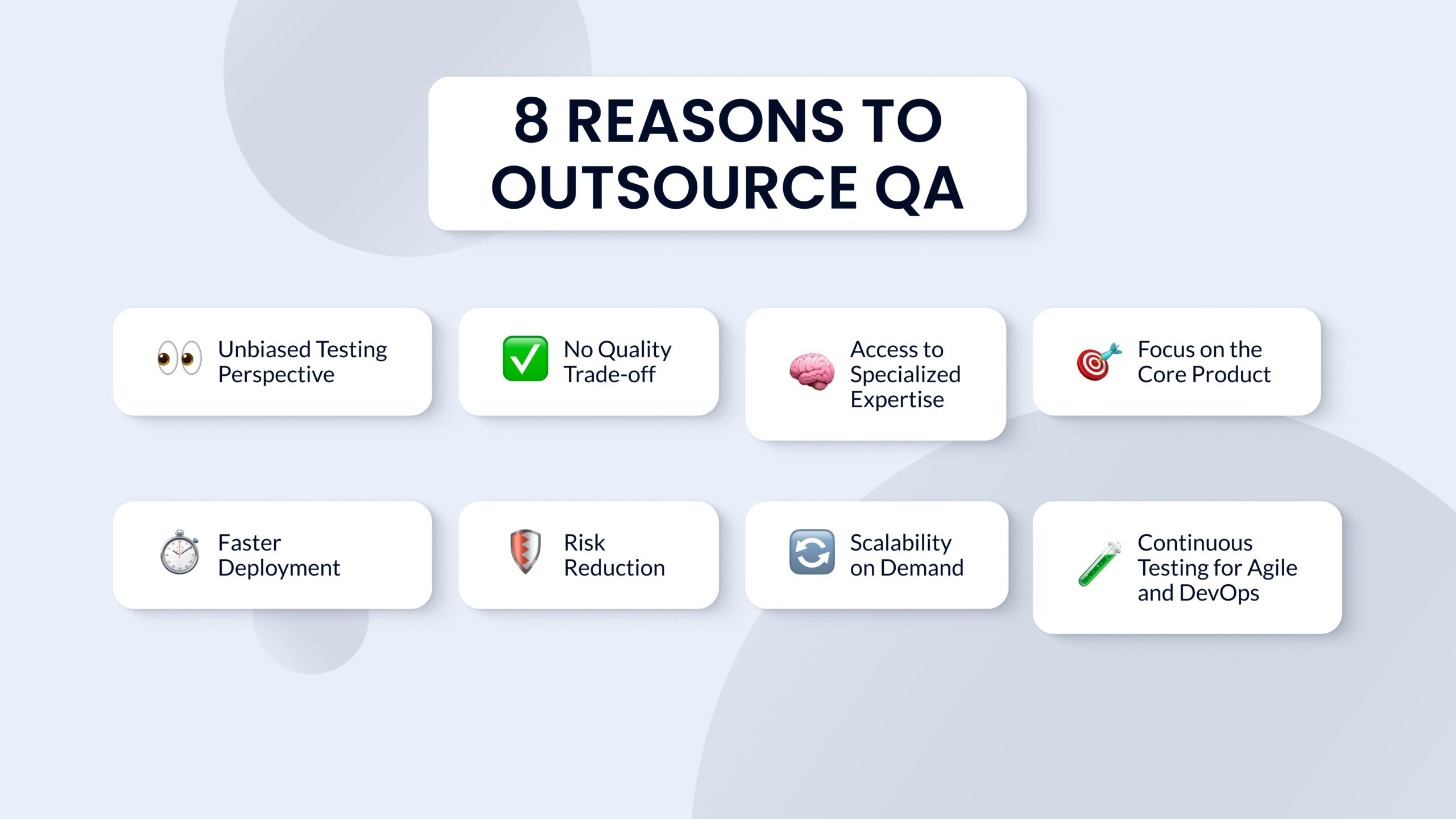
1. Unbiased testing perspective
QA professionals from outside your team come with no internal bias and are more likely to test like real users, catching edge cases and usability issues your internal team might miss due to “product blindness.”
2. Access to specialized expertise
QA partners often have deep experience across domains, tools, and testing methods (manual, automation, performance, security, etc.). You instantly gain access to this knowledge without lengthy hiring or training cycles. According to the World Economic Forum’s Future of Jobs Report, technical and analytical roles remain among the hardest to fill globally, making external expertise even more valuable.
3. Faster deployment
With a dedicated external QA team, testing can run in parallel with development, even 24/7 if needed, accelerating release cycles and helping you launch faster without compromising quality.
4. Scalability on demand
Need 10 testers this month and 2 next?
Software testing outsourcing companies
let you change your team based on your project phase or budget, avoiding long-term staffing commitments.
5. No quality trade-off
Hiring and retaining in-house QA engineers (especially automation or performance experts) is expensive. Outsourcing allows access to top talent at competitive rates and often with better results.
6. Focus on the core product
When QA is outsourced, your internal teams can concentrate on building features and solving business problems while the partner ensures everything works as expected.
7. Risk reduction
External QA partners often have structured, mature processes (ISO 9001, ISTQB-certified engineers, SOC 2 controls) that reduce risk and support regulatory compliance. This is a growing concern as 73% of enterprises now embed ESG and governance criteria into their procurement scorecards (Mordor Intelligence).
8. Continuous testing for Agile and DevOps
In 2026, Agile and DevOps workflows are everywhere, which makes continuous testing crucial. By 2026, 40% of large organizations will embed QA into DevOps culture as a continuous process, not a checkpoint. External teams can plug into your CI/CD pipelines so quality is baked into every release.In 2025, Agile and DevOps workflows are everywhere, which makes continuous testing crucial. Outsourced teams can integrate with your CI/CD pipelines to ensure quality is baked into every release.
Where do you outsource QA?
Now that the reasons to delegate QA are obvious, let’s get to the practical part: How do you
outsource software testing
?
The key part here is to choose a reliable and cost-efficient vendor.
Popular Locations for QA Outsourcing
Thanks to remote work, you can choose any region you want. These are some of the countries that are known for strong tech expertise, competitive pricing, and a large pool of skilled engineers.
- Ukraine. Deep tech talent, strong communication skills, affordable prices, large pool of specialists.
- Poland. High-quality engineering, EU data regulations, cultural alignment with the West.
- India. Large talent pool, flexible pricing, strong English skills. Ideal for scaling.
- Romania. EU member, excellent infrastructure, strong IT sector.
- Philippines. Strong English fluency, good for manual testing and customer-centric QA.
- Argentina. Time zone alignment with the US, affordable rates, rising tech ecosystem.
What to look for in a QA partner?
Before you sign a contract, assess potential partners based on these criteria:
- Expertise in your tech stack. Can they handle your tools and frameworks (Selenium, Appium, TestRail…)?
- Industry experience. Healthcare, fintech, e-commerce? Choose a partner who understands the compliance and workflows in your domain.
- Certifications and methodologies. Look for ISTQB-certified testers and companies with ISO or CMMI certification.
- Flexible engagement models. Need just one tester or a whole team? See if they offer outstaffing, dedicated teams, or per-project QA.
- Clear communication and time zone overlap. Daily standups? Urgent bug reports? Make sure their working hours align with yours or that they have a clear handoff process.
- Trial period or pilot project. Start small. A test project can show how they work before you sign a long-term contract.
How to evaluate a QA partner?
Here’s a QA partner evaluation checklist to help you assess performance after, say, 3 months of collaboration. Use it to ensure your QA partner is truly adding value and aligned with your expectations:
1. Technical quality
- Are bugs consistently well-documented with reproducible steps?
- Do they follow your tech stack, tools, and processes correctly?
- Are test cases thorough, structured, and updated?
- Are automation tests stable and integrated into your CI/CD?
2. Collaboration and communication
- Do they attend all relevant meetings (standups, sprint planning, retros)?
- Are they responsive and clear in communication (Slack, email, calls)?
- Do they raise red flags early (unclear requirements, blocker bugs)?
- Is the time zone overlap or async workflow working smoothly?
3. Ownership and initiative
- Do they proactively suggest improvements or spot inconsistencies in specs?
- Are they independently managing their workload and deadlines?
- Have they taken ownership of key QA modules or test suites?
4. Integration into your team
- Do they align with your culture and team rituals (feedback, demos, humor)?
- Have they developed working relationships with your team?
- Do they feel like part of your team, or are they just external help?
5. Results and metrics
- Has the defect leakage rate decreased?
- Has test coverage improved?
- Has time-to-release shortened or become more predictable?
- Are regressions and critical bugs being caught early?
Score them 1 to 5 on each section. If they average under 3, it’s time for a deeper conversation. If they’re 4+, congrats, you’ve likely got a keeper.
Recommended QA partners by region
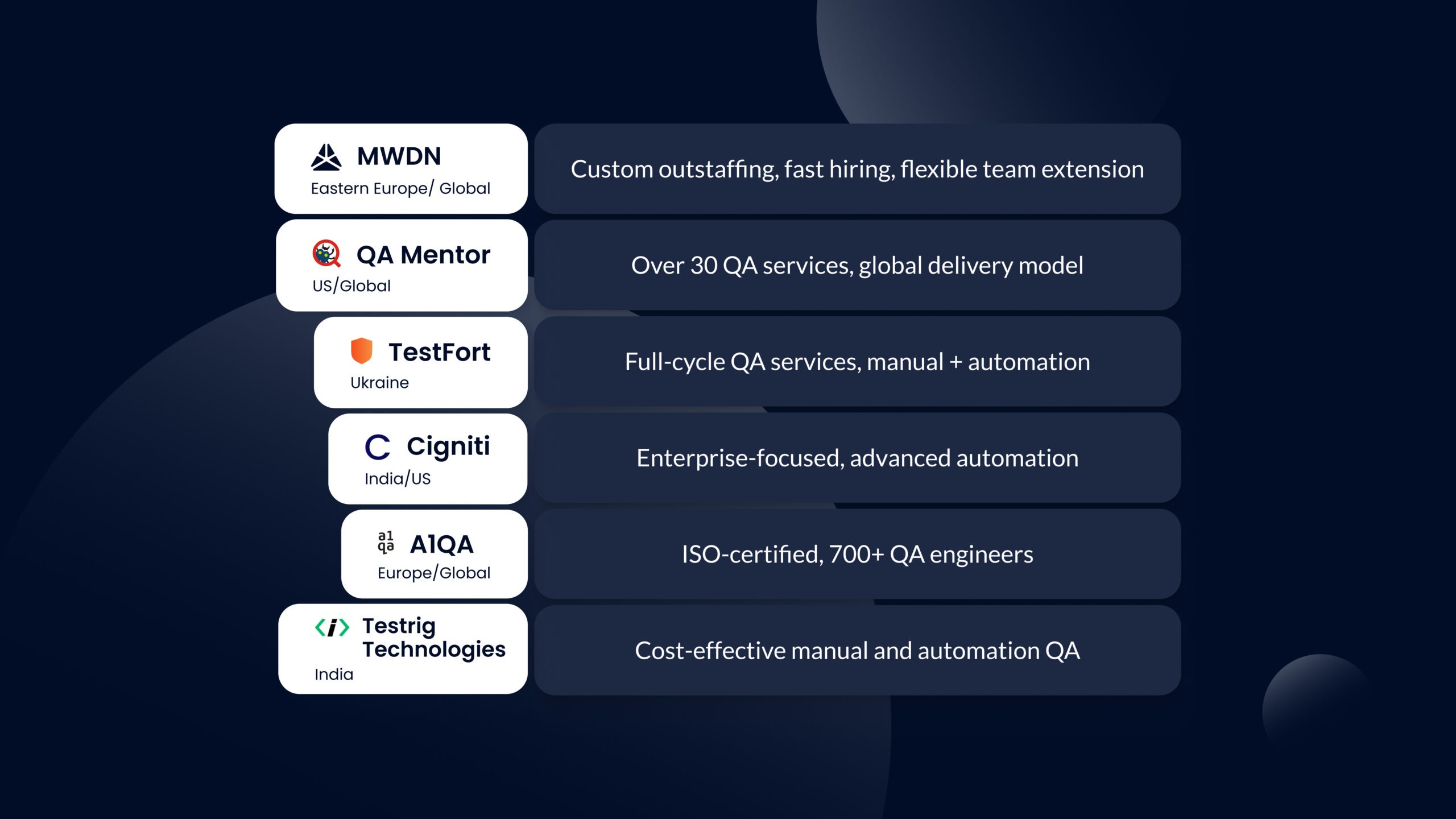
Below is a curated list of well-regarded QA testing companies grouped by region. Use this as a starting point for your shortlist; final selection depends on your stack, industry, and engagement model.
Eastern Europe
- MWDN (Ukraine) – staff augmentation focus, vetted QA engineers and SDETs across manual, automation, and performance testing.
- TestFort (Ukraine) – full-service QA testing services since 2001, strong in functional and performance testing.
- QATestLab (Ukraine) – independent testing house with experience in fintech, healthcare, and e-commerce.
- TestArmy (Poland) – security and accessibility testing, ISTQB-aligned processes.
- Testronic (Poland) – game testing, localization QA, and compliance testing.
Western Europe
- Bitbar / SmartBear – cloud-based device testing and continuous testing platforms.
- Sogeti (Capgemini) – enterprise testing, security, and SAP QA services.
North America
- QualityLogic (USA) – accessibility testing (WCAG/ADA), payment systems, and IoT.
- Cigniti Technologies (USA / India) – independent QA at enterprise scale.
- QASource (USA / India / Mexico) – managed QA pods for product companies.
Asia
- TestingXperts (India) – AI-driven testing accelerators, RPA, and automation.
- ThinkSys (India) – SaaS and cloud-native QA, plus annual QA Trends Report.
- Symphony Solutions (Philippines / EU) – manual and automated testing pods.
Latin America
- BairesDev (Argentina / regional) – staff augmentation and outsourced QA across nearshore LATAM.
- NaNLABS (Argentina) – embedded QA engineers for product startups.
Tip: Always validate any shortlisted vendor with two reference calls (recent and past clients) and a paid pilot before committing to a long-term outsourcing contract.
How to make your QA outsourcing as efficient as possible?
To make your QA outsourcing truly efficient, hiring skilled testers might not be enough. You will need to create the right processes and communication flow. Two areas are especially crucial: solid documentation and tight collaboration with your development team. Here’s how to get it right:
Start with strong documentation
Clear, thorough documentation is the backbone of successful QA outsourcing. It reduces guesswork, shortens onboarding time, and makes sure your remote engineers test the right things.
- Create detailed test plans and acceptance criteria. QA engineers should know exactly what success looks like in user flows, edge cases, and performance thresholds.
- Maintain updated user stories and technical specs. Outdated docs lead to testing the wrong behavior. Keep your documentation living and aligned with the latest sprint goals.
- Use collaborative tools (Confluence, Notion…). Make sure testers have access to the same knowledge base your dev team uses.
Ensure continuous communication with developers
When testers and developers are in sync, bugs are found (and fixed) faster. Here’s how to bridge the gap:
- Involve QA early. Don’t wait until dev work is “done.” Bring QA into planning sessions and sprint kickoffs. They’ll catch issues before code is even written.
- Use the same communication channels. Slack, Microsoft Teams, Jira comments: QA and devs should speak the same language in the same spaces.
- Create feedback loops. Encourage testers to flag unclear functionality, not just bugs. Developers, in turn, should clarify edge cases and expected behaviors.
- Daily or bi-weekly standups. Keep QA in the loop on what’s shipping, what’s breaking, and what needs more testing.
What else?
- Automate regression testing where possible to free up time for exploratory testing.
- Track metrics like defect leakage and test coverage to measure quality over time.
- Assign a QA lead or point of contact to coordinate communication between your in-house and outsourced teams.
In our experience helping product companies build distributed QA teams, the single biggest predictor of success is not seniority – its onboarding depth in the first 2 weeks. Teams that pair an external QA engineer with an internal developer “buddy” for 10 working days reach productive testing roughly 40% faster than teams that hand over a Jira board and a Confluence link. The cost of that buddy time is trivial compared to a slow start.
How much do outsourced software testing services cost compared to in-house testing?
Outsourcing offers significant cost advantages over maintaining an in-house team, especially when considering global salary differences. Here’s a comparative overview of the average annual salaries for mid-level QA engineers in various countries (as of May 2025), which can help you choose the right outsourcing destination:
Average annual salaries for mid-level QA engineers (USD)
Outsourcing QA testing services offers significant cost advantages over maintaining a fully in-house team, especially when global salary differences are factored in. The table below shows approximate annual gross salaries for mid-level QA engineers in 2026.
| Aspect | Staff Augmentation | Traditional Outsourcing |
|---|---|---|
| Who manages the work | You do - your tech leads and PMs | The vendor's project manager |
| Who owns the outcome | You | The vendor, per SOW / SLA |
| Team integration | Deep - engineers join your standups, sprints, retros | Limited - vendor team works in their own silo |
| Tools and processes | Your stack: Jira, Slack, GitHub, your CI/CD | Vendor stack |
| Reporting line | Direct to your engineering manager | Vendor account manager |
| Knowledge retention | Stays partly inside your org | Stays primarily with vendor |
| Pricing model | Hourly or monthly per engineer | Fixed price per project / outcome |
| Scaling | Person-by-person, weekly to monthly | Whole team, project-by-project |
| Onboarding time | 1-4 weeks | 2–8 weeks, with discovery phase |
| Best for | Long-term, evolving product scope | Self-contained, well-defined deliverables |
Sources: Glassdoor 2026, PayScale, ERI SalaryExpert, Alcor research.A US company hiring an in-house mid-level QA engineer at ~$100,000/year (gross) typically pays a fully loaded cost of $130,000-$150,000 once benefits, payroll taxes, equipment, and overhead are added. The same role staffed via Eastern Europe or LATAM through staff augmentation usually lands at $50,000–$70,000 fully loaded – a 50-60% reduction. Hiring offshore in India or the Philippines can push savings even higher, though communication overhead and time-zone coordination should be factored in.
Practical example: A US-based SaaS company we worked with replaced 2 in-house QA hires (combined cost ~$280,000/year) with three augmented Ukraine-based engineers (combined cost ~$165,000/year). They gained one extra tester and reduced cost by ~40%, while keeping the same Jira workflow and reporting line.
What are the risks and drawbacks of QA outsourcing?
QA outsourcing can offer many benefits, but it’s not without risks. Here are the key risks and drawbacks to be aware of when outsourcing QA, along with insights on how to deal with them.
Communication barriers
Issue: Time zone differences, language gaps, and cultural differences can lead to misunderstandings or delays.
Solution: Choose vendors with strong English proficiency and overlapping working hours; schedule regular check-ins and use collaboration tools like Slack or Jira.
Limited product understanding
Issue: External QA teams may not have deep knowledge of your product or business logic, especially in the early stages.
Solution: Provide thorough documentation, product walkthroughs, and access to developers to ensure alignment.
Security and confidentiality risks
Issue: You’re entrusting sensitive data and proprietary code to a third party.
Solution: Use NDAs, secure communication channels, and ensure the vendor complies with relevant data protection regulations.
Quality inconsistency
Issue: Not all outsourcing vendors maintain the same level of QA rigor or standards.
Solution: Start with a pilot project, define clear KPIs, and conduct regular performance reviews.
Lack of ownership
Issue: External teams may be less invested in the long-term success of your product.
Solution: Build long-term relationships, motivate high performance, and integrate them as part of your extended team.
Dependency on vendor
Issue: You may become overly reliant on a single vendor, which can be risky if they underperform or terminate the contract.
Solution: Avoid single-vendor dependency. Maintain knowledge transfer and consider dual sourcing or hybrid models (in-house + outsourced).
Time zone misalignment
Issue: Limited overlap in working hours can delay feedback loops.
Solution: Choose regions with partial time zone overlap or implement an asynchronous workflow that’s supported by clear documentation.
Worth noting: the Deloitte 2024 Global Outsourcing Survey reported that 70% of executives have selectively insourced scope previously handled by third parties over the last five years, usually because of governance gaps. The lesson isn’t “don’t outsource”; it’s “design the engagement model carefully so you keep control where it matters.”
What are the better alternatives to traditional QA outsourcing?
A strong alternative to traditional QA outsourcing is staff augmentation, and in many cases, it’s a better choice. Here’s why staff augmentation stands out compared to the typical outsourcing model.
Staff augmentation vs. traditional QA outsource
Staff augmentation means hiring QA engineers who join your internal team remotely through a staffing partner. They work under your direction, follow your processes, and become an integrated part of your development cycle. Just like full-time employees, but without the long-term obligations.
The table below compares both models side-by-side across the criteria that actually drive outcomes.
| Model | When it fits |
|---|---|
| Outsourcing | Defined scope handed to a vendor with limited day-to-day integration. |
| Dedicated team | Stable external team operating as a separate unit, long-term. |
| Internal hiring | Long-term core roles where stability outweighs slower time-to-fill and higher overhead. |
Why is staff augmentation a better alternative?
You get more control. With traditional outsourcing, you hand off QA to an external team. With staff augmentation, you retain control over workflows, tools, and priorities. Engineers adapt to your processes and not the other way around.
Better team integration. Augmented staff participate in daily standups, planning meetings, and sprint reviews, making collaboration smoother than with traditional outsourced teams.
Greater transparency. You get full visibility into the QA work, timelines, and progress with no surprise delays.
Faster knowledge transfer. Because augmented engineers work within your team structure, they gain product knowledge faster and become more effective over time.
Fewer communication gaps. Staff work in your tools (Jira, Slack, GitHub, etc.), follow your hours (or overlap enough), and report directly to your product or engineering leads.
In-house QA with augmented tools
Your internal QA engineers are supported by external staff augmentation specialists or automation tools. This model combines deep product knowledge with flexible scaling.
Why should you give it a try? With this model, you keep your core team in-house while using augmented staff to fill skill gaps (test automation, performance testing) or handle temporary workloads. This hybrid gives you the best of both worlds: ownership with elasticity.
It would be ideal if you already have a QA lead or core team, but want to accelerate without hiring full-time. Use it to increase coverage, introduce automation, or reduce delivery bottlenecks without sacrificing internal standards.
Best for: Startups, growing product teams, or companies with unique testing requirements that need additional hands-on support without committing to full-time hires.
Managed QA services
This is an external provider that fully handles the QA process, from test planning to execution and reporting. You get a plug-and-play QA team managed externally.
Why? With managed services, you can focus on building your product, and your QA partner ensures quality. Managed QA is scalable, process-driven, and less time-consuming on your end. However, you trade off some control.
This model will be perfect for companies launching new products or managing multiple streams of testing. Use this when QA is essential but you don’t want to recruit, train, and manage a team in-house.
Best suited for mid-sized and enterprise companies with complex or regulated products, or those requiring consistent QA without incurring internal management overhead.
Summing up
If you want the cost efficiency of outsourcing combined with the quality, control, and culture-fit of an in-house team, staff augmentation is usually the strongest choice. It’s especially well-suited to tech companies with strong internal processes that want to scale QA without losing visibility or speed.
MWDN specializes in staff augmentation for QA teams, matching companies with vetted manual testers, automation engineers, SDETs, and performance specialists who integrate quickly and stay focused on your product. Engineers are pre-screened on technical skills, communication, and product thinking, and onboarded into your tools and rituals within 1-4 weeks.
Want to see how this could work for your team?
- Schedule a consultation with our hiring team to discuss your QA needs.
- Get a hiring estimate for a custom QA pod (manual + automation + performance).
Hire QA engineers as part of your extended team.