In 2026 when companies think about custom app development, they rarely choose between design options or coding frameworks. They make their business decisions based on speed, ownership, scalability, security, and user experience. Custom mobile app development means building software around your business, not adapting your business to someone else’s software.
The stakes match the market size. According to Fortune Business Insights, the global mobile application market is projected to grow from $330B in 2026 to over $1 trillion by 2034 (a 15.1% CAGR) with Android holding around 70% of global smartphone share, which is why custom Android app development services have become a core line item for B2B product roadmaps.

This article covers what custom mobile app development services include, when to pick them over templates or web, how the process actually works, what realistic costs look like in 2026, and how to evaluate a partner, including for custom Android app development services or broader mobile product delivery. With over 23 years of experience and deep expertise in highly regulated sectors such as healthcare, including SaMD and HIPAA-compliant systems, MWDN brings the technical precision and vetted talent needed for complex mobile product development.
What is custom mobile app development?
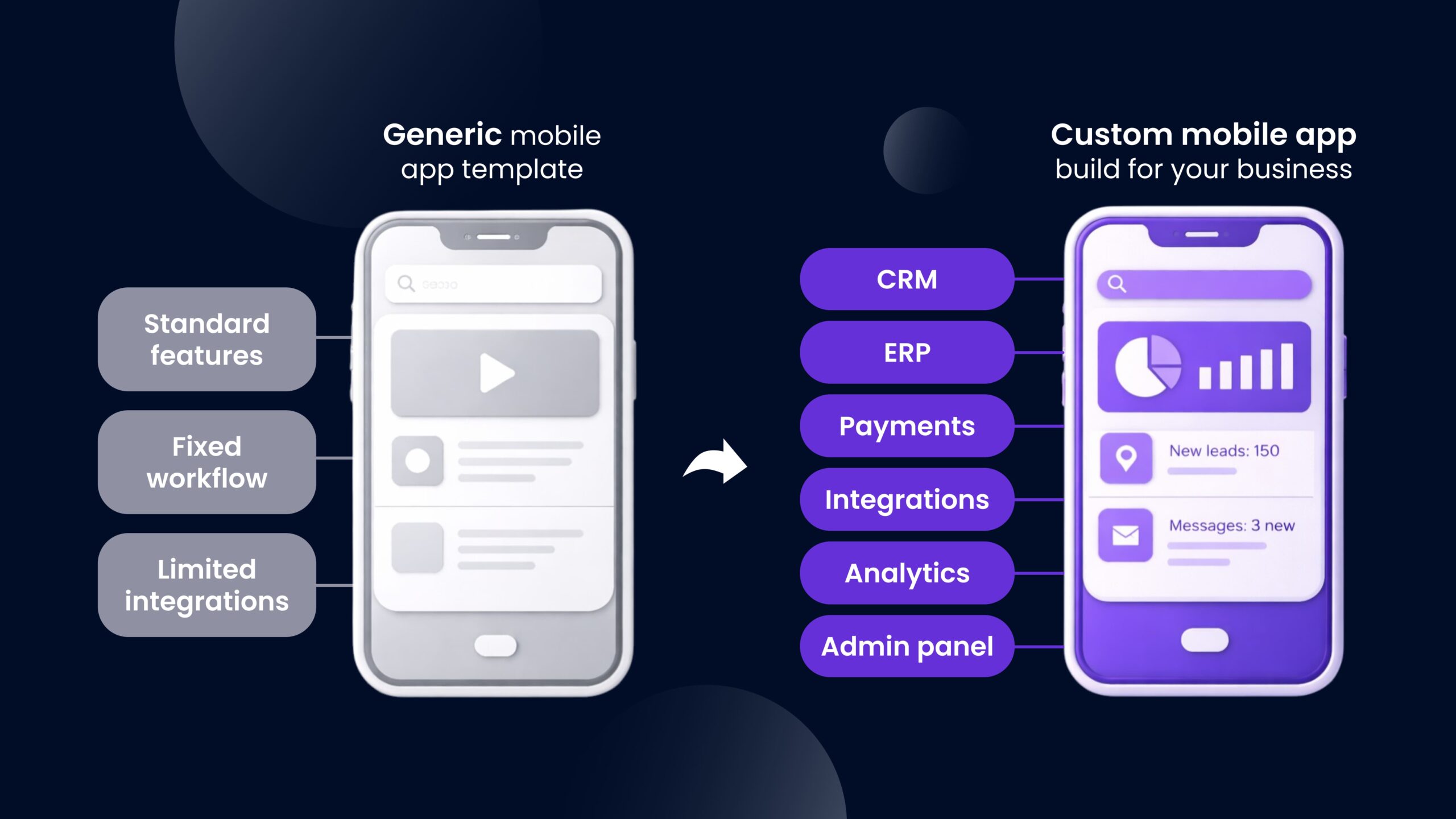
Custom mobile app development is the process of creating a mobile application specifically designed for a company’s purposes, users, internal workflows, and business model. Instead of relying on generic off-the-shelf solutions, you define the feature set, user flows, integrations, security standards, analytics, and monetization logic based on your own needs.
You can create a custom mobile app for customers, employees, partners, or all three. Some companies need customer-facing products for industries like ecommerce, fintech, healthcare, logistics, or media. Others invest in internal tools for field teams, operations, reporting, onboarding, or inventory management.
This is why the value of custom mobile app development services lies in control. A business can define how the product should work today and how it should evolve as processes, users, and priorities change. This approach is especially relevant for B2B companies that need more than a polished interface. They often require integration with CRM, ERP, payment systems, internal dashboards, admin panels, and third-party APIs. In these cases, a custom solution is usually more strategic than a template-based one because it supports business logic instead of forcing the business to adapt to software limitations.
Custom mobile app development vs off-the-shelf and web solutions
The choice between developing a custom mobile app, off-the-shelf tools, and web solutions is not about choosing the “best” format. It’s about choosing the option that fits your business model, user expectations, and long-term product goals.
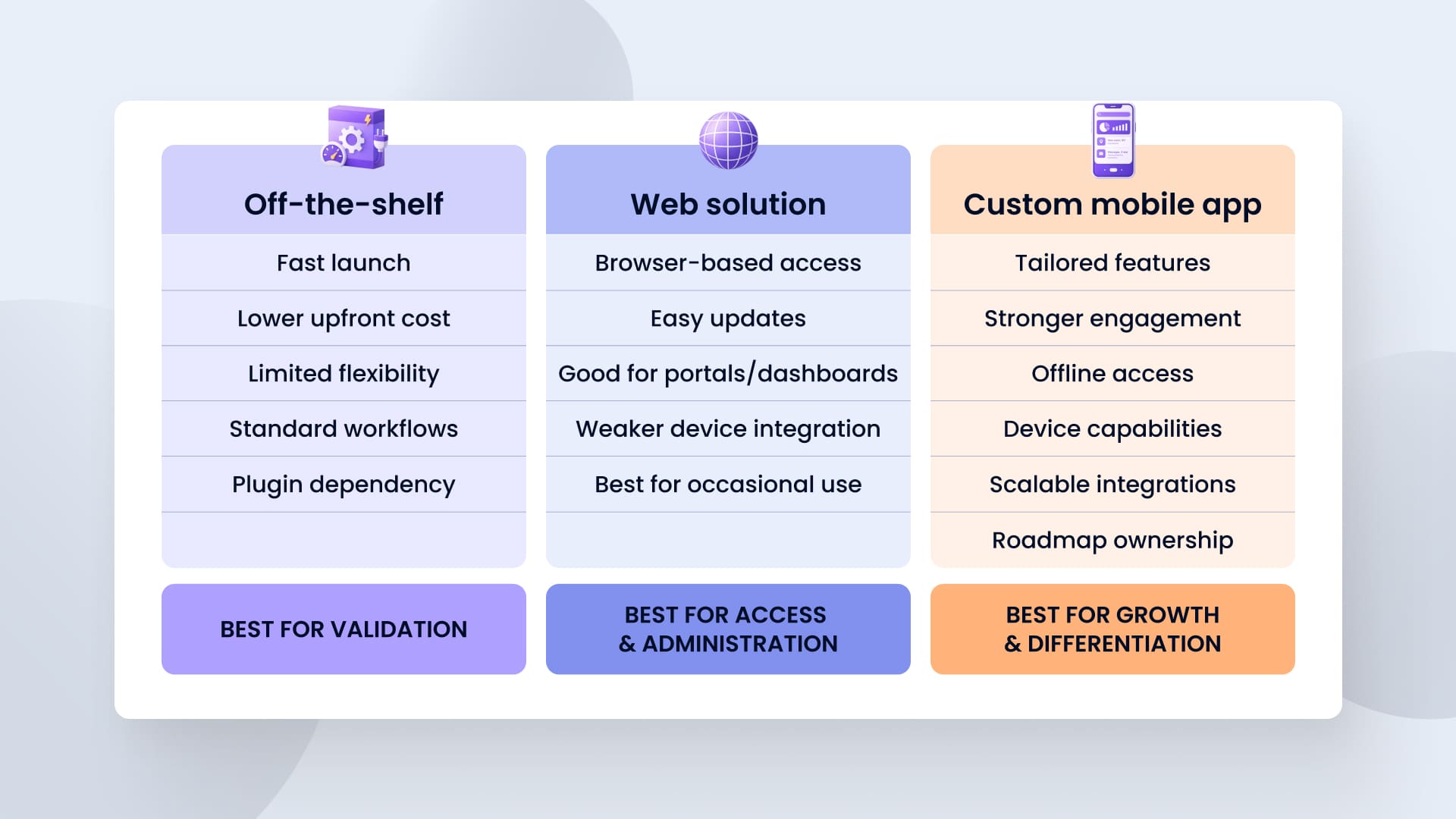
Pros & cons of mobile apps
Mobile apps win when habit and convenience matter – push notifications, biometric login, offline access. Web wins for occasional use and easy access. For most B2B companies, the right answer in 2026 is a hybrid: a web control center plus a mobile layer for field teams and customers who need answers in their pocket.
| Monetization model | Best for | Main benefit |
|---|---|---|
| Subscription | SaaS, health, education, productivity | Recurring revenue |
| One-time purchase | Simple utility apps | Easy pricing |
| In-app purchases | Content, features, upgrades | Flexible upsell |
| Advertising | Media, mass audience apps | Monetizes reach |
| Transaction fees | Marketplaces, booking, exchanges | Revenue per action |
In practice, mobile app development makes the most sense when the product is expected to drive long-term engagement, recurring revenue, or operational efficiency. That is why many businesses treat it as a strategic investment rather than just another digital channel.
Native, cross-platform, and hybrid: which custom approach to choose?
Choosing the architecture is a business decision, not just a technical one. It determines burn rate, time-to-market, and whether users feel they’re using a premium tool or a clunky workaround.
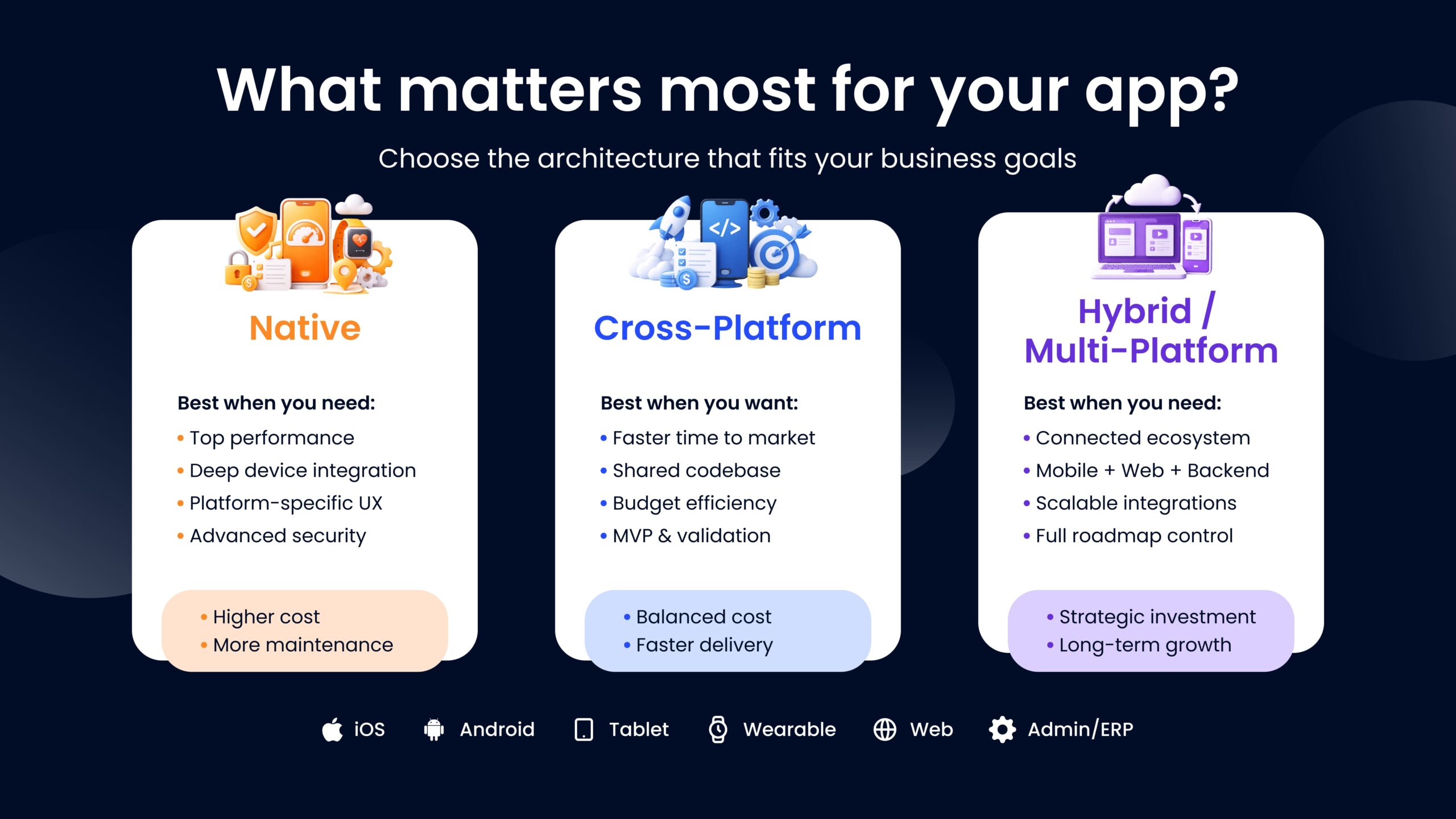
Here’s in details about these approaches:
Native app development (iOS and Android)
Remains the gold standard for high-performance products. It involves creating two separate applications: one in Swift (iOS) and one in Kotlin (Android). If you need to squeeze the most power out of your phone’s hardware or require perfect animations, this is the choice for you.
We typically recommend native development for sectors such as fintech, healthcare, and heavy logistics, where custom Android app development services or iOS-specific delivery may be needed to meet stricter performance, security, and platform requirements.
Shortly, it’s expensive. You’re not just doubling the code, you’re doubling the quality control, edge cases, and specialized talent you need on staff.
Cross-platform app development
For most businesses in 2026, cross-platform is the pragmatic winner. Tools like Flutter and React Native have reached such a level of maturity that the average user can’t tell them apart from native apps. Meanwhile, Kotlin Multiplatform (KMP) has become a favorite among teams that want to share core logic while maintaining user interface flexibility.
Cross-platform is probably the best choice if:
- you need to dominate both App Stores simultaneously without doubling the price
- your MVP needs to be in users’ hands yesterday
- the core value of the app is utility and data, not complex 3D rendering
Especially for B2B tools, “perfection” should not be the enemy of “release”. A stable, scalable app that works on all devices often outperforms a native app that is six months behind schedule.
Which platforms support custom app development?
When we talk about “platforms”, we need to look beyond the smartphone in your pocket. Today’s personal ecosystem is rarely just an app; it’s a network of touchpoints.
A comprehensive strategy typically includes:
- iOS and Android for the mobile core;
- web dashboards for heavy administrative work;
- wearables and tablets for specialized field work or health tracking;
- internal systems to connect mobile workflows to your backend.
The real question is not just “which platform” to choose. It’s how these elements interact with each other to create a seamless experience for your team and your customers.
The custom app development process and lifecycle
The app development lifecycle is not just a sequence of technical tasks. It is the structure that helps your company move from an idea to a scalable product with fewer surprises. When your team asks how to develop a mobile app? They usually focus on coding. But in reality, success depends on the full app development process, from discovery to post-launch improvements.
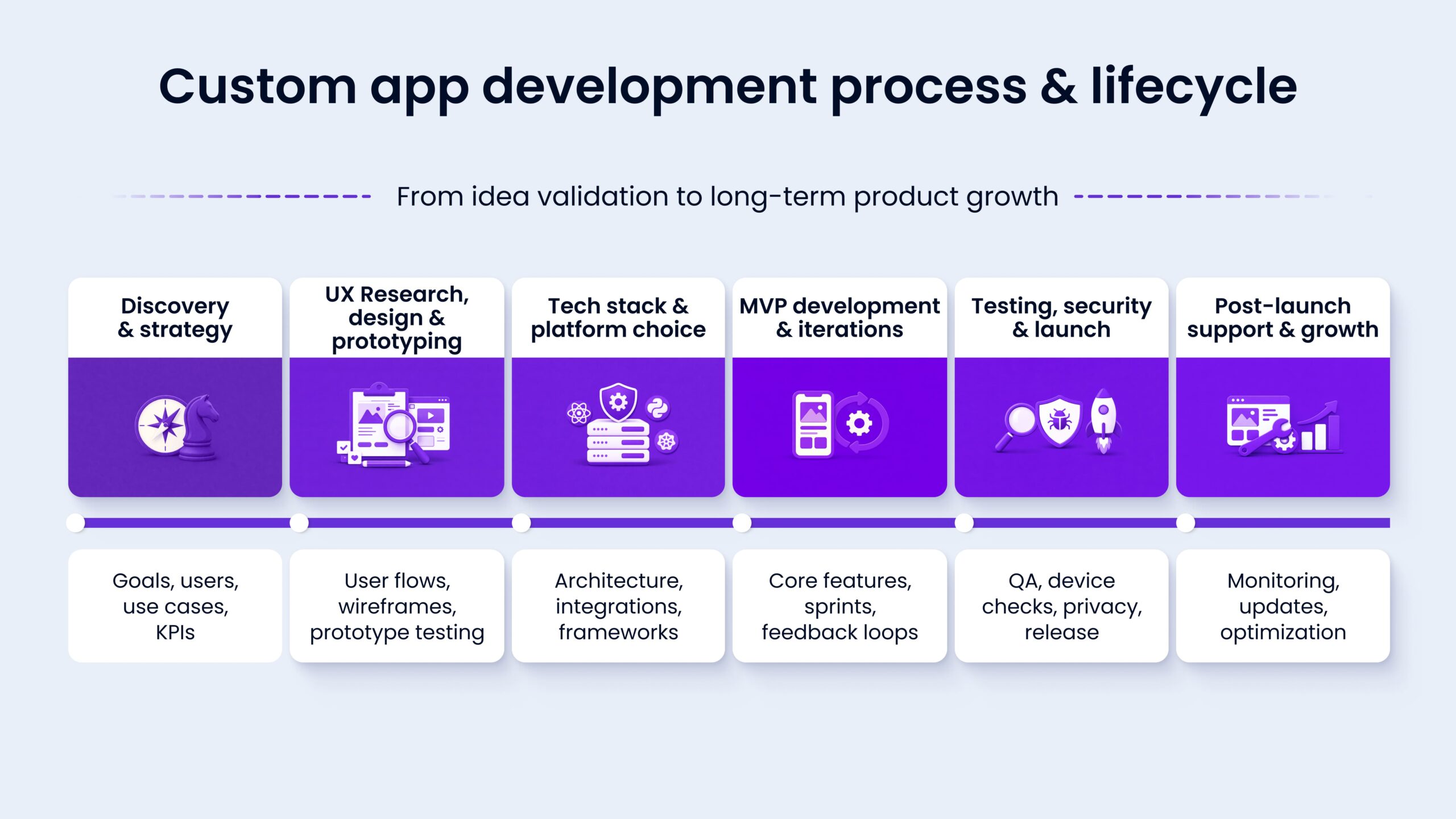
Let’s go through the process and lifecycle step-by-step:
Discovery & strategy
Every good product starts with clarity. Discovery helps define your business goals, your product’s target users, its main use cases, the competitive environment, technical constraints, and launch priorities.
At this stage, we need to find answers to the following questions:
- What problem does the app solve?
- Who will use it and how often?
- What features are essential for the first release?
- What systems should it integrate with?
- What are the business KPIs?
Without the discovery stage, companies often overestimate or underestimate critical requirements too early. A strong partner should help turn a business idea into a roadmap for implementation, not just estimate hours of work.
UX research, mobile app design, and prototyping
Mobile app design is not just about visuals. It’s also about user flows, screen logic, accessibility, hierarchy, navigation, and conversion paths. This is especially important for B2B apps, where performance and clarity are just as important as brand perception.
This is where mobile app prototypes come in handy. Prototypes will help your team test assumptions early on, gather stakeholder feedback, and identify issues before development begins. What will this achieve? It will save you time, reduce rework, and improve decision-making.
A prototype can be anything from a low-fidelity clickable concept to a fully interactive flow. Either way, it turns abstract ideas into something your team can evaluate.
Choosing tech stack & app development platforms
The next step is to determine how your product will be built. This stage includes: backend architecture, databases, APIs, infrastructure, integrations, security controls, and frontend selection.
It is at this stage that companies often compare application development platforms and mobile app development frameworks. But your decision should be based on your product’s needs, not on general trends. A simple internal app can benefit from a fast cross-platform approach. A complex product with high performance requirements, on the other hand, may require a native architecture. If your company has a mature web platform, this may require a mobile layer that connects to existing services.
The choice of framework also has long-term implications. React Native, Flutter, and Kotlin Multiplatform continue to evolve today. But each of these frameworks is suited to different team structures and development priorities.
Development phase (MVP & iterations)
You should start your development process with an MVP rather than a full feature set. The first release, which typically focuses on specific tasks, will help your company launch the product faster, observe user behavior, and set priorities based on real-world feedback.
This phase includes:
→ backend setup
→ frontend implementation
→ API integration
→ user authentication
→ administration tools
→ analytics setup
→ core business logic
→ sprint reviews and iterative releases
For many companies, the smartest approach to mobile app development is to start smaller than expected. First, create the smallest version that proves your product’s value, and then scale up.
Testing, security & launch
Testing is not just about fixing bugs. It involves evaluating your product’s usability, functional quality control, device compatibility, performance assessment, security testing, release readiness, and store submission.
In 2026, security deserves special attention. The OWASP Mobile Application Security project remains the practical benchmark for mitigating mobile risks, Google’s Android security guidelines emphasize secure data exchange and permission management, and Apple continues to require accurate App Privacy disclosures for apps and third-party SDKs alike.
You should never view launch as the finish line. It is only the beginning of learning in real-world conditions.
Post-launch support & continuous improvement
Once your business is up and running, you’ll need to monitor it, roll out updates, analyze performance, fix bugs, ensure compatibility with operating systems, enhance functionality, and make decisions about scaling.
This is where a long-term partner plays a crucial role. A team that understands the product’s context can improve customer retention, optimize workflows, and ensure support for future versions without having to build up knowledge from scratch.
Cost of custom app development in 2026
When our clients ask how much it costs to develop a custom mobile app, they usually want to hear a single, specific figure from us. But in reality, the cost of developing a mobile app depends on the scope of work, complexity, integrations, level of design detail, security requirements, choice of platform, and the team’s working model.
A simple MVP with a limited set of features can cost significantly less than a multifunctional enterprise app with large-scale integrations, custom dashboards, advanced analytics, and platform-specific functionality.
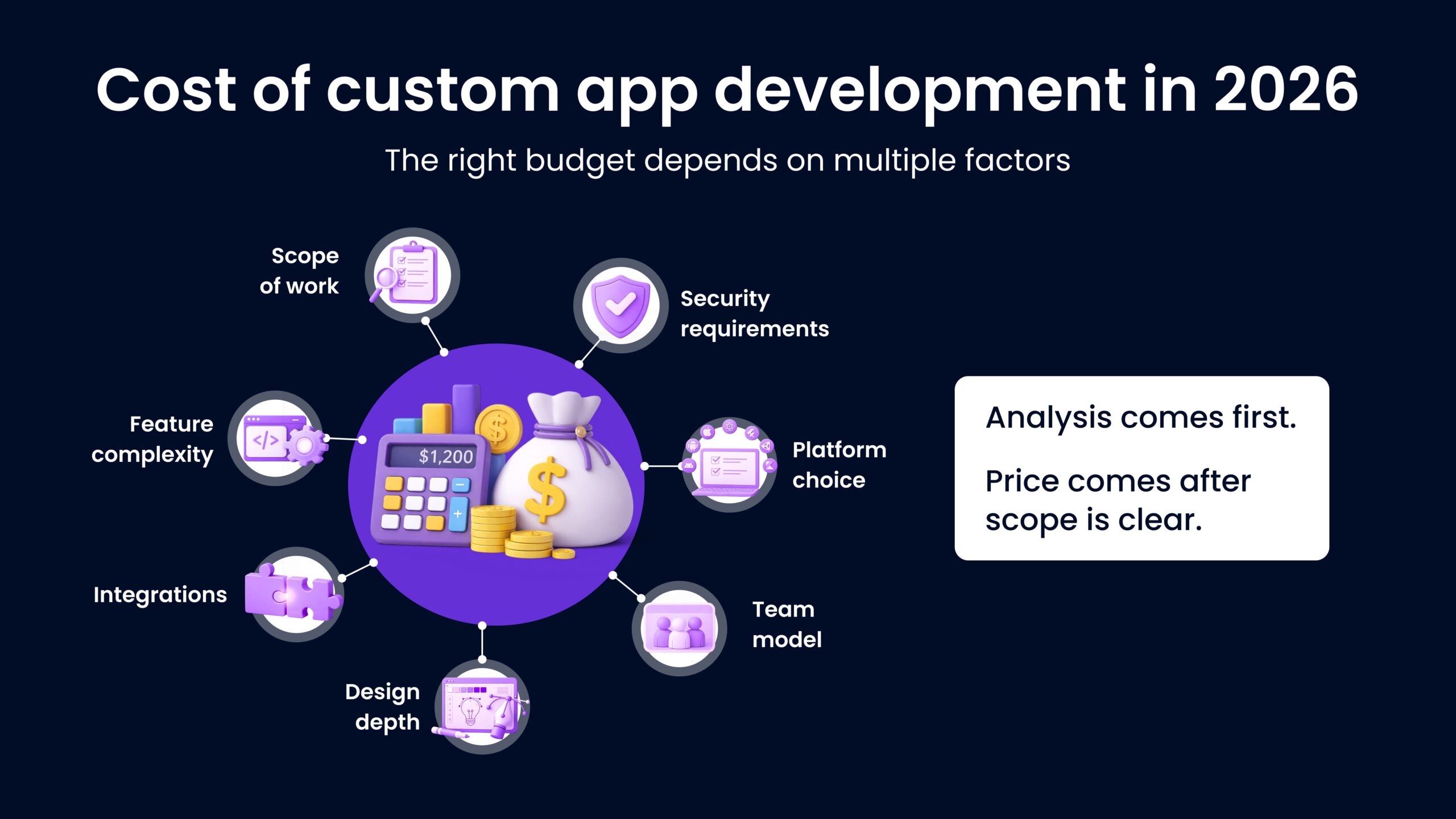
Realistic approach to pricing is to take complexity into account:
If you want a basic business application or an MVP, it typically includes login functionality, profile management, a few core user scenarios, limited server-side logic, and standard user interface templates.
If you’re planning to develop a mid-tier application, this is often supplemented with payment features, third-party APIs, dashboards, additional user roles, or a more advanced user experience.
If you’re opting for a complex application, it may include custom workflows, offline mode, real-time communication, AI features, high security requirements, or deep integration with internal systems.
That’s why cost estimation starts with analysis. Until the scope of work is clearly defined, any price is just an approximate range.
Another key factor is the project delivery model. It is precisely in this regard that outsourcing and specialized teams allow you to optimize your budget without compromising on quality. Instead of building a large in-house team from scratch, you can collaborate with external engineers, designers, quality assurance specialists, and mobile technology experts who already have project implementation experience. This shortens hiring times, reduces operational costs, and gives you the flexibility to scale your team up or down as product needs change.
MWDN’s portfolio reflects both directions. For example, Better Chains was created as a restaurant app for staff and management to support scheduling and daily operations. While iRoofing is a mobile solution for the roofing industry that helps assess projects, select materials, simulate results, and support service delivery in the field.
Monetization strategies for custom mobile apps
Knowing how to monetize your app is just as important as knowing how to build it. Monetization shouldn’t be an afterthought, something tacked on at the end as an afterthought. It should influence user flows, your user retention strategy, pricing communication, and your product’s priorities from the very beginning.
| Area | Why backend developers matter |
|---|---|
| Product logic | Backend developers build the logic that makes key product actions work correctly behind the interface. |
| Business operations | A polished frontend is not enough if the backend cannot support real user actions, workflows, or system tasks. |
| Complex features | Products with payments, dashboards, user accounts, admin panels, and integrations depend on a strong backend structure. |
| Stability | Backend developers help keep the product reliable as more features, users, and data are added. |
| Scalability | A well-built backend makes it easier to grow the product without creating too many technical problems. |
| Delivery risk | Strong backend support helps teams launch updates, connect services, and change workflows with less risk of errors or system issues. |
Choosing the right model depends on your audience and product category.
A subscription model is well-suited for apps in industries such as SaaS, media, productivity, health, and education. This is because it provides a steady stream of revenue and incentivizes developers to continuously improve their product.
A one-time purchase option which is fairly simple to implement. However, it is not as flexible when it comes to long-term growth and product development. If your product includes updates, additional content, special features, or virtual items, in-app purchases may be the better option.
An advertising option can work for apps that target a broad audience, but it’s often not a good fit for business products unless you’re in media or marketing.
Transaction fees option allows users to book, purchase, or exchange services.
In the B2B segment, monetization mechanisms may be less obvious to the end user. An app may help retain customers, improve operational efficiency, drive cross-selling, or increase lifetime value, rather than directly encouraging in-store purchases.
The most effective approach is to link monetization to the delivery of value. If the app saves time, improves access, increases usage, or supports premium workflows, the revenue model should clearly reflect this.
How to choose custom mobile app development company
Choosing a custom mobile app development company is about more than just reviewing a portfolio. It’s about finding a team that can understand the specifics of your business, challenge false assumptions, and execute the project in a way that drives its growth.
Signs you need a custom solution
You likely need a custom solution if your product is the cornerstone of your business model, if your workflows are too specific to use templates, or if the quality of your customer service is what truly sets you apart from the competition.
Other key indicators include:
✓ Your current tools are creating obstacles to your work
✓ You need integration between multiple business systems
✓ Your team wants to have a greater say in the product’s direction
✓ Requirements for scalability, privacy, or security are increasing
✓ You want to launch an MVP and gradually expand it based on real-world data
“The success of a custom mobile app project rarely comes down to code. It comes down to whether product vision, budget, scope, and team structure are aligned before development starts. We see the same pattern in healthcare SaMD work, in B2B SaaS, in field-service tools — when those four are aligned at discovery, the rest of the lifecycle gets predictable. When they’re not, no framework choice fixes it.”
— Vitalii Vystavnyi, Managing Partner, MWDN
If you are still deciding whether a custom solution is the right move, MWDN can help you make that choice with more clarity. With over 23 years of experience, our team supports various businesses in evaluating product ideas, defining the right scope, and choosing the best delivery approach based on your goals, technical needs, and growth plans. Contact us to discuss your project.
Checklist for selecting a custom mobile app development company
A good selection process should go beyond “How much?” and “How fast?” Look for a partner that can:
- Understand your business goals, not just your feature list
- Explain trade-offs between native and cross-platform options
- Structure a clear discovery phase
- Support product strategy, design, development, QA, and launch
- Show relevant experience in mobile delivery
- Work flexibly with dedicated teams or team extension
- Communicate clearly about risks, scope, and priorities
- Plan post-launch support, not only the initial release
Ask how they estimate, how they handle roadmap changes, how they build teams, and how they approach ownership and documentation. A strong partner should make the process clearer, not more confusing.
Why companies choose MWDN for custom app development
Companies choose us because they need more than just technical expertise. They need a partner capable of combining product-oriented thinking, flexibility in staffing, and highly effective engineering solutions.
MWDN supports companies by offering specialized teams, customized service models, and access to experienced professionals in mobile development, design, quality assurance, product support, and backend development. This is particularly valuable for companies seeking to get to market faster without shouldering the full burden of in-house staffing from day one.
From a business perspective, our company is the perfect fit for you if you are looking for:
- flexible scalability
- predictable collaboration
- expertise in mobile technology, backed by extensive software development capabilities
- a team structure capable of evolving alongside the product
- support for both building an MVP and implementing a long-term development plan
If you’re planning to create a mobile product, update an existing app, or decide whether to implement your idea as a native app, a cross-platform app, or first as an MVP, contact MWDN for a consultation. A focused discussion will help you determine the scope of work, budget, and implementation model before development begins.
Summary
Custom mobile app development is the right choice for companies that need greater control, better scalability, and a product that aligns with their business goals. Unlike off-the-shelf solutions, a custom app is built with your workflows, users, integrations, and growth plans in mind.
In 2026, the best approach depends on your priorities. Some companies need native apps for maximum performance and deep integration with devices. Others opt for cross-platform development for a faster launch and better budget efficiency. In many cases, the strongest solution is a connected ecosystem that includes mobile, web, and backend systems.
The success of a mobile product also depends on the entire process. From needs assessment and design to development, testing, launch, and post-launch support. Cost is determined by complexity, functionality, integrations, security requirements, and the team’s working model. That’s why choosing the right development partner is just as important as choosing the right technology.
Whether you’re scoping an MVP, deciding between native and cross-platform, or planning long-term custom Android app development services, we can help you map scope, budget, and delivery model before development starts.
FAQ
How do I know if my business is ready to start a custom mobile app project?
At MWDN, we often work with companies that have the business goal but not the full product plan yet. In that case, the first step is not immediate development. It is a discovery discussion that helps define scope, priorities, must-have features, and the best delivery path. This makes the project more realistic from both budget and timeline perspectives.
What should I prepare before talking to a custom mobile app development company?
At MWDN, we do not expect clients to come with a perfect technical brief. What helps most is business clarity. If you can explain what problem the app should solve and who it should serve, our team can help shape the product direction, architecture choice, and delivery model from there.
Who should be involved on my side during a mobile app development project?
At MWDN, we usually recommend a clear communication structure from the beginning. That helps the project move faster and reduces confusion during discovery, design reviews, and sprint planning. Our team can adapt to your internal setup, but the best results usually come when responsibilities and feedback ownership are defined early.
What happens if my priorities change during the project?
At MWDN, we treat change as part of product development, not as a failure of planning. The key is to make trade-offs visible. If a new feature becomes important, we help clients understand what it means for scope, release timing, and team effort. This gives businesses flexibility while keeping the project structured and predictable.
Can a development partner help after launch with scaling the app and team?
At MWDN, we support both launch-phase delivery and longer-term product growth. That can include ongoing development, QA, design updates, backend support, and team extension as the roadmap expands. This is especially useful for businesses that want to scale gradually without rebuilding the entire team structure each time the product grows.