In software and product delivery, projects rarely slow down because of code. More often, it happens because of unclear ownership, missed approvals, conflicting priorities, or late feedback from the people involved. That is why stakeholder alignment matters. As it helps teams communicate clearly, set expectations early, and reduce surprises as delivery moves forward.

So what do stakeholders do in practice? They approve, influence priorities, raise risk issues, and make final decisions – which influences the results as well. Decisions are made faster and the project remains stable when they support the objectives. They may block approvals, ask that work be re-evaluated, or even cause delays that affect deadlines if they feel ignored or disagree with the project’s direction.
What are stakeholders?

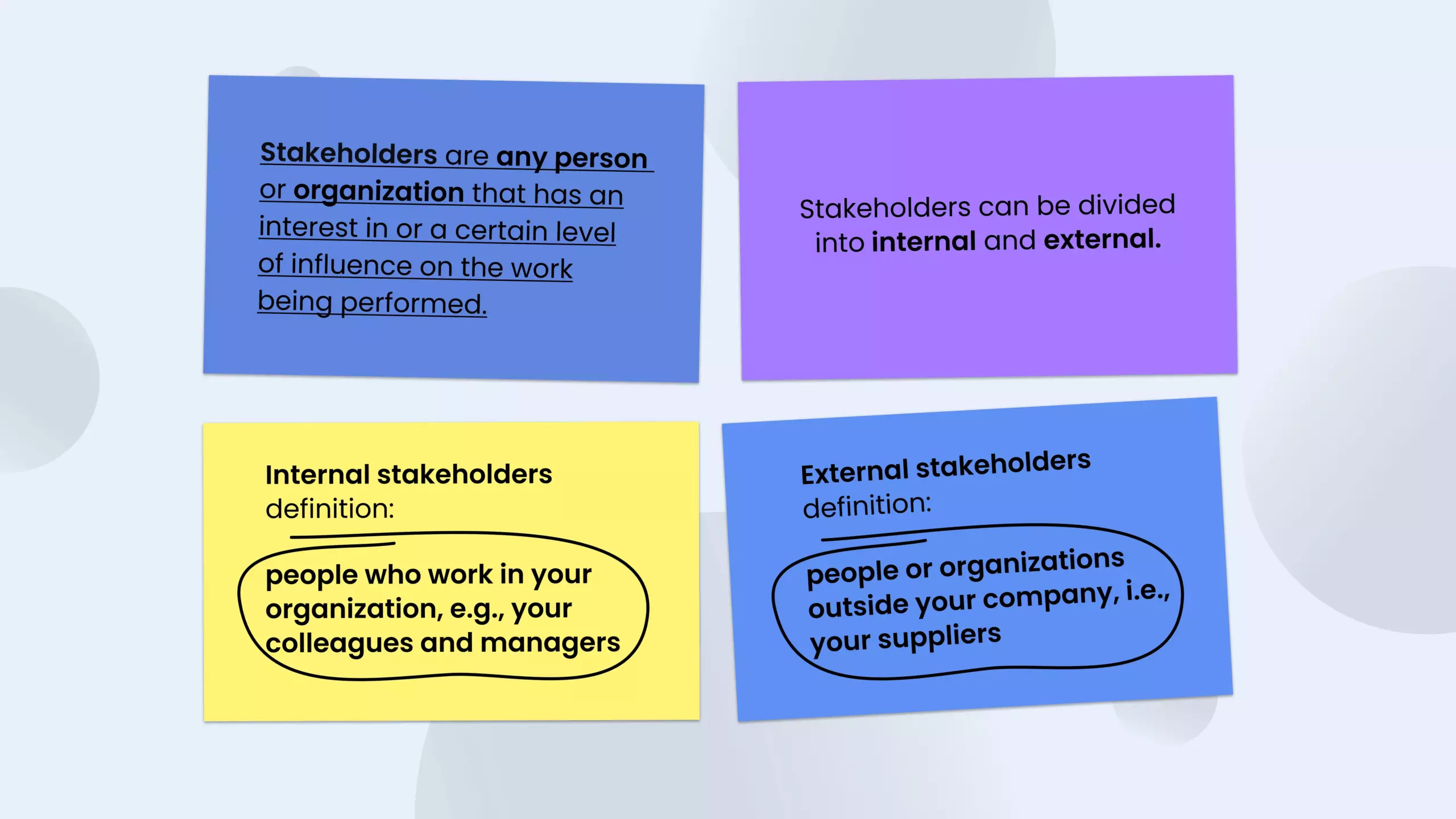
There are many people in the project environment who have a stake in its success. They aren’t just the ones providing funding or managing the project. They may include product owners, engineers, security teams, procurement departments, and those directly involved in the project. There are also customers, suppliers, and internal departments that help bring the project to life. Each of them plays a role: some determine what needs to be done, while others influence how quickly it will be done or how much funding will be allocated.This is truly important for the development team, because even if a project is technically flawless, it can get stuck if the opinion of even one influential stakeholder is not taken into account. Or a project may be technically ready for release, but it will still be delayed due to legal review, security concerns, procurement procedures, or unclear approval from the client.
Why is stakeholder management important?
Stakeholder management is an important process for many organizations and projects and has a number of advantages and applications. For example:
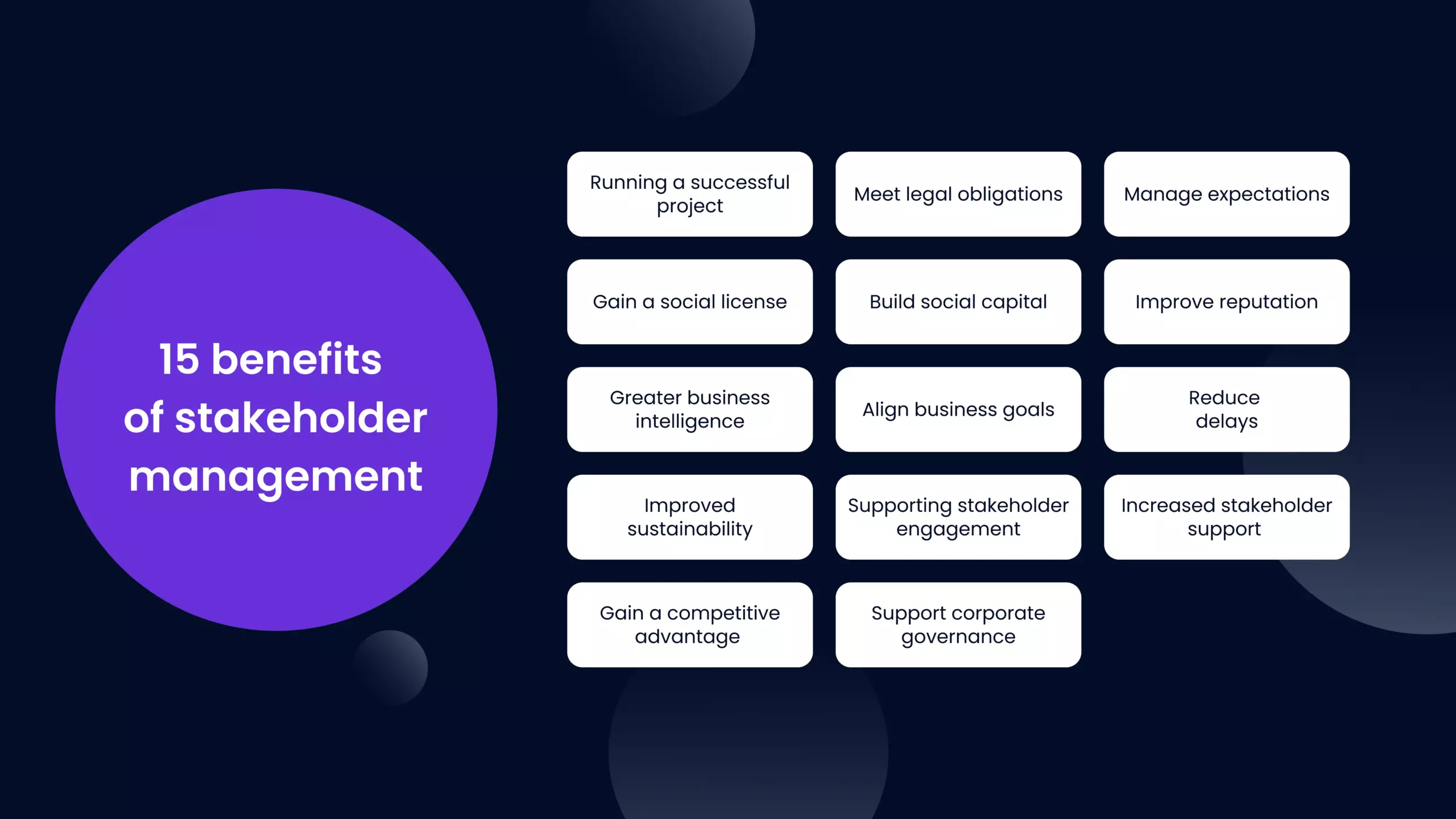
Strong stakeholder alignment helps projects move with fewer delays, fewer approval gaps, and less avoidable friction. When teams identify stakeholders early on and understand their interests, they can develop a clear approach to engagement, communicate more consistently, and manage expectations before they turn into conflicts.A structured communication and engagement process helps ensure compliance (e.g., with privacy and access to information requirements) and reduces business risks. In large organizations, this becomes especially important when several departments are involved. It helps teams identify issues early, avoid delays, and gain greater stakeholder support through transparency and trust. Over time, this process can improve reputation, build social capital and a “social license to operate”, enable better business analysis, support sustainable decisions and management, and even create a competitive advantage by identifying opportunities and risks more quickly.
Stakeholder management in project management
One of the core responsibilities in project delivery is making sure the right people are involved at the right time and in the right way. This means identifying stakeholders, understanding their interests, and developing strategies to engage them throughout the project lifecycle.This requires more than good communication. Teams need to understand which stakeholders have decision power, which ones carry operational risk, what information each group expects, and when their involvement matters most.The following tips will help you get started:
Identify your stakeholders
To develop a stakeholder management strategy, first identify who your stakeholders are and categorize them into internal and external groups that may influence (or be influenced by) your initiative. Internal stakeholders may include departments such as marketing, sales, or operations, while external stakeholders may include customers, suppliers, partners, or the local community.Once you have compiled a list, assess the interests and influence of each stakeholder. This will help you decide where to focus your time and effort. For example, a key customer may require close interaction due to their high interest and influence, while a community member may require attention because their influence is strong, even if their interest is low.
Prioritize your stakeholders
Once you have identified the stakeholders, prioritize them so that you can focus your time and resources on the people who are most important to the success of the project. The main factors are interest in the project, authority to make or block decisions, and influence over others. After evaluating these factors, rank stakeholders in order of priority so that the most important ones are kept informed and involved in the project throughout its duration.
Interview your stakeholders
To prioritize and manage stakeholders, you need to understand what matters to them, and interviewing stakeholders is a practical way to do that. Even if you think you already know your stakeholders, talking to them directly often gives you a clearer understanding of their expectations, concerns, and the best way to work together.Useful questions include:
- What does success look like from your perspective?
- What risks concern you most?
- What information do you need before making a decision?
- How do you prefer updates and feedback to be handled?
- What could create dissatisfaction or delay on your side?
Create an influence and interest matrix
The influence-interest matrix is a simple framework for mapping stakeholders according to their level of influence (power) and their level of interest or influence (interest). Some versions also add a “significance” indicator, e.g., how visible and important the needs of the stakeholder are during planning. Teams use this diagram to identify key stakeholders, understand who can influence decisions, and choose the right approach to communication and interaction. This is a fundamental step in the stakeholder management process, as it determines how you interact with each group.
Set and manage expectations
Stakeholder management begins with clear expectations. From the outset, it is important to be honest about what is possible and what is not, and when results can realistically be achieved. Setting realistic expectations for both stakeholders and the team helps prevent misunderstandings and builds trust, which is the foundation of effective stakeholder management.
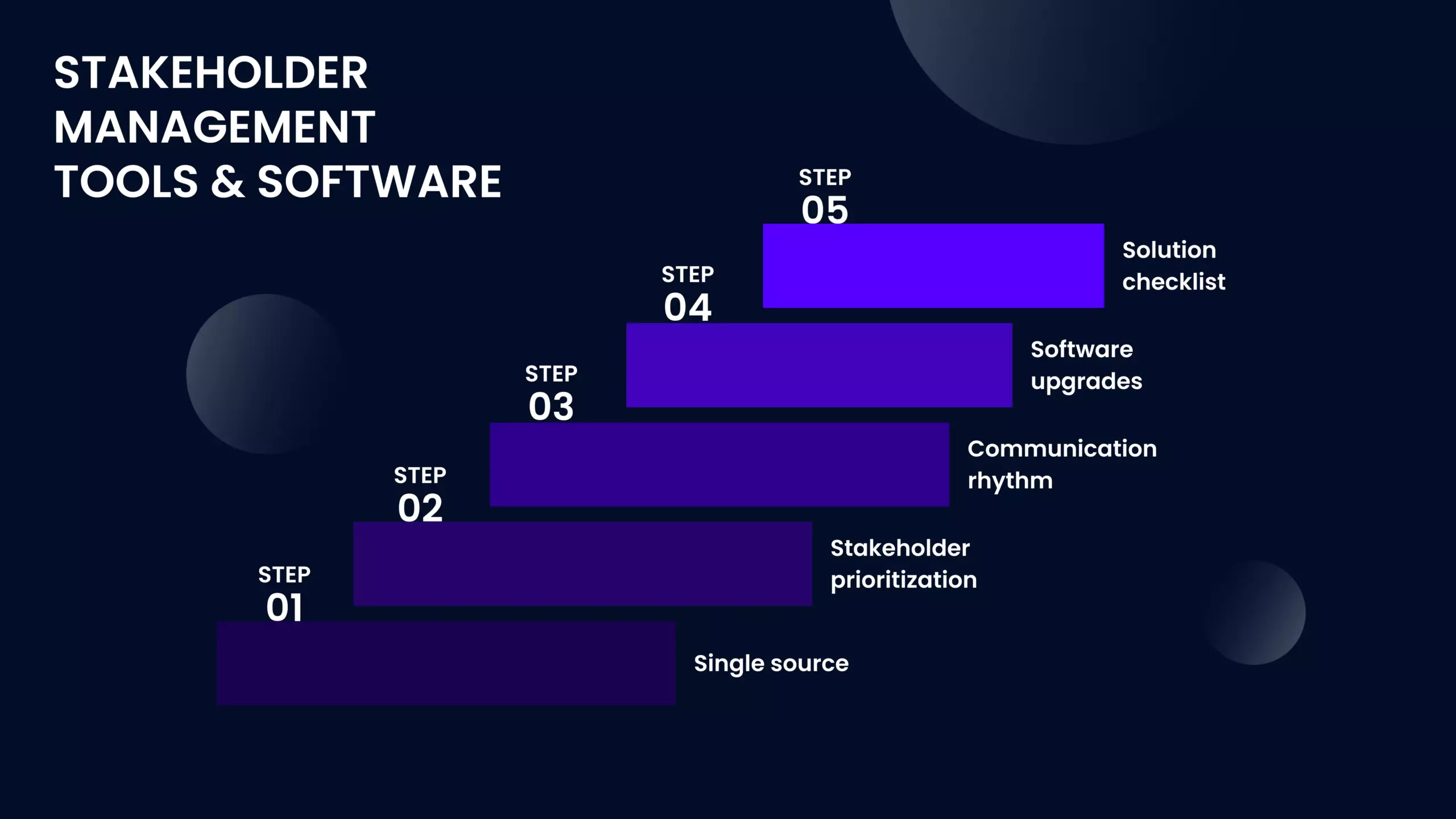
Core stakeholder management tools & software
Start with the basics: a single source of truth
Stakeholder work becomes confusing when information is scattered across chat rooms, documents, and people’s heads. The simplest “tool” that solves this problem is a clear stakeholder register: a living list of stakeholders, what they care about, what influence they have, and who on your team is responsible for their relationship. When this register is constantly updated, decisions are made faster because everyone knows who to involve (and who not to involve).
Use analysis tools to avoid guesswork
Visual mapping tools help teams prioritize. Some stakeholders require close interaction and frequent check-ins. Others simply need to be informed of key milestones. This stakeholder management process prevents two common problems: over-communicating with everyone (noise) or missing the one person who can block progress (risk).
Make communication predictable, not reactive
Communication works best when it follows a rhythm: what will be communicated, when, in what format, and for what purpose (informing, obtaining feedback, approval, or coordination). Predictable communication is not so much about “more messages” as it is about consistent expectations and timely decisions.
When spreadsheets stop working, switch to software
A spreadsheet works until the list of stakeholders grows, several people start logging conversations, or you need to track history over months. At that point, dedicated tools become useful for tracking conversations, open issues, follow-ups, ownership, and changes over time.
What a “good” stakeholder management solution looks like
The best stakeholder management tools don’t feel cumbersome. They make it easy to update your registry, ensure ongoing communication, and identify risks in a timely manner. If a tool helps your team stay on top of who’s important, what they need, and what’s next, it’s doing its job.Examples of tools teams often use include Jira for issue and dependency tracking, Confluence or Notion for stakeholder registers and communication plans, Miro for mapping influence and interest, and Asana or Monday for follow-up ownership and coordination.
Key features of effective stakeholder management software
Software becomes valuable when it supports the real work behind stakeholder engagement: maintaining clear relationships, realistic expectations, and consistent communication. The best tools don’t just store contacts! They help teams understand who matters most, plan the right level of engagement, and keep reliable track of decisions and follow-ups so nothing gets lost as the project gains momentum.
| CRM option | Best suited when | What it helps with |
|---|
| CRM for sales (primarily for potential customers) | The biggest challenge is potential customers → deals → forecasting | Lead capture, pipeline stages, follow-ups, quotes, forecasting, sales reporting |
| Marketing relationship management (MRM) tools | You run campaigns and need better control over segments + interactions + marketing activity | Segmentation, campaign planning, interaction tracking, lead nurturing; can connect contacts/opportunities/campaigns and integrate with a customer-interaction CRM (e.g., Microsoft Business Central relationship management features) |
| CRM for service/support | Support volume is growing and agents need context fast | Ticketing, customer history, SLAs, knowledge base, routing, faster resolution |
| Comprehensive CRM packages (sales + marketing + service) | You want one platform across teams, with fewer tools | Unified customer view, shared data across sales/marketing/support, automation, cross-team reporting (integration still matters) |
| CRM + ERP combination (when orders and inventory are important) | Customer work must connect to operations like orders and stock | CRM for interactions + ERP for back-office (order processing, inventory, finance) integration between them for a smoother lead-to-cash flow |
Stakeholder management strategies & best practices in 2026
In 2026, stakeholder coordination is less about ensuring project stability. The best approach is proactive: identify the people who can influence the outcome, understand what is important to them, and maintain ongoing communication as the project evolves. If done correctly, stakeholders will help you move faster. If ignored, stakeholders can inadvertently cause delays, rework, and scope changes. These stakeholder management strategies help teams stay aligned, reduce conflict, and ensure predictable outcomes.

In most projects, stakeholders can have the greatest influence on the direction of development in the early stages, when the scope of work is still flexible and decisions are easier to adjust. Later on, changes become expensive, and late feedback often leads to conflicts or delays. A practical stakeholder management strategy is to engage key stakeholders early on, agree on the definition of “success”, and set realistic expectations from day one.
Effective stakeholder management begins with understanding who is important and why. Make a list of stakeholders (a registry), then rank them by level of influence and interest to focus your time on those who can change the outcome. An “influence-interest” matrix will help you decide who to work closely with, who to keep informed, and who to simply monitor.
A stakeholder management plan should link analysis with action: who you will interact with, what topics are important to them, how you will communicate, and who on your side is responsible for each interaction. Good plans also define how to collect feedback and how to validate decisions so that interactions do not remain “pleasant conversations” without results.
Best practice is not “more updates”. It is the right message, addressed to the right stakeholder at the right time, as well as genuine listening. Recommendations for stakeholder engagement often emphasize the need for early and frequent consultation, building trust, and recognizing that stakeholders are people (with their own concerns, emotions, and varying tolerances for risk).
Stakeholders demand change when they feel uncertainty or risk, and this pressure can alter the scope and timing of work. Instead of reacting late, keep expectations in mind: what will happen, what will not happen, what “done” means, and what decisions need to be made (and by when). This reduces last-minute changes in scope and helps maintain predictability of execution.
Stakeholder management is not a one-time workshop. Priorities change, new stakeholders emerge, and attitudes shift based on what people hear and feel. Make it a habit to review stakeholder status, update your plan, and record key interactions so your team doesn’t lose context and repeat old mistakes.
Stakeholders influence each other: internal teams influence customer experience, customers influence revenue, revenue influences management pressure, and so on. Effective stakeholder management strategies balance outcomes and avoid optimizing for one group while inadvertently creating conflicts in others.In software delivery, stakeholder problems rarely show up as “relationship issues.” They usually appear as delayed approvals, repeated meetings, conflicting assumptions, last-minute scope changes, or work that has to be redone after late feedback.
The future of stakeholder coordination in software delivery
The future trends in stakeholder coordination is less about “having a plan” and more about maintaining a continuous relationship process. Stakeholders change, priorities shift, and expectations evolve as you move forward, so teams need a simple way to keep alignment visible and updatable, rather than buried in a one-off document. The most successful approaches focus on clear expectations and regular interaction, as stakeholder support can speed up decision-making or slow down the entire project.Tools will continue to improve, but they cannot replace the human factor. Software can help teams organize stakeholders, track communication, and identify risks at an earlier stage. But relationships, trust, and “early and frequent consultation” remain the key factors. In other words, software supports the work, but people still do it.
How MWDN can help
Expanding the product development team through outstaffing or hiring new employees often leads to the emergence of new stakeholders: product owners, engineering managers, HR/procurement specialists, security specialists, and a new group of remote specialists who must adapt to the client’s working methods.
MWDN helps reduce this complexity by providing outstaffing and outsourcing services with specialized teams or staff expansion, while focusing on ensuring that remote specialists adhere to the client’s principles and are aligned with the client’s company goals.MWDN also takes pressure off the operational side, which often creates friction between stakeholders: recruitment and hiring efforts, as well as the myriad of formalities associated with personnel and employment. This means less side conversations and delays around questions of “how do we hire” and “who manages what”, and more focus on getting things done and clear expectations. In practice, this facilitates a smoother alignment of stakeholder interests, as roles are clearer, new employees adapt more quickly, and the team can communicate in a single, coordinated rhythm.
FAQ
What is stakeholder management?
Stakeholder management is the practice of establishing and maintaining good working relationships with people or groups connected to your project. It involves identifying stakeholders, understanding what is important to them, setting expectations, and keeping them engaged through clear and timely communication. The goal is simple: fewer surprises, faster decisions, and smoother execution.
What is a stakeholder in project management?
A stakeholder in project management is anyone who can influence a project, who is affected by its outcome, or who believes they are affected by it. This can include sponsors, users, managers, implementation teams, suppliers, regulatory bodies, and partners. Stakeholders are important because they influence scope, priorities, approvals, and acceptance.
Why is stakeholder management important?
Because stakeholders control key levers: budget, priorities, requirements, access to people, and approvals. Effective stakeholder management reduces delays, prevents chaos in the scope of work, and increases support for decisions. When stakeholders feel informed and respected, projects are implemented with fewer difficulties.
What is stakeholder analysis in project management?
Stakeholder analysis is the stage at which you identify stakeholders and assess their needs, degree of influence, and likely response to change. Teams often classify stakeholders by degree of influence/interest to decide who to work closely with, who to keep updated, and who to provide targeted support to.
What is a stakeholder register in project management?
A stakeholder register is a living document (or workspace in stakeholder management software) that lists stakeholders and key details: role, influence, interests, expectations, communication preferences, point of contact, and any risks or concerns. It is updated as the project progresses.
What is a stakeholder management plan?
A stakeholder management plan describes how you will interact with stakeholders: who receives what information, how often, in what format, and for what purpose (information, coordination, approval, feedback). It also defines responsibilities – who on your team manages each key relationship.
Who are the stakeholders in project management?
Common stakeholders include: project sponsor, product owner, executive management, project manager, implementation team (development/quality assurance/DevOps), operations department, security/compliance department, procurement department, end users, customers, suppliers, and external partners. The exact list depends on the project’s impact and management.
What are the four processes involved in managing project stakeholders?
The overall structure uses four processes:
- Identifying stakeholders (who matters and why)
- Planning stakeholder engagement (strategy + communication approach)
- Managing stakeholder engagement (communication, involvement, conflict resolution)
- Monitoring stakeholder engagement (tracking changes, adjusting the plan as influences and needs change)


 In software and product delivery, projects rarely slow down because of code. More often, it happens because of unclear ownership, missed approvals, conflicting priorities, or late feedback from the people involved. That is why stakeholder alignment matters. As it helps teams communicate clearly, set expectations early, and reduce surprises as delivery moves forward.
 So what do stakeholders do in practice? They approve, influence priorities, raise risk issues, and make final decisions – which influences the results as well. Decisions are made faster and the project remains stable when they support the objectives. They may block approvals, ask that work be re-evaluated, or even cause delays that affect deadlines if they feel ignored or disagree with the project’s direction.
 There are many people in the project environment who have a stake in its success. They aren’t just the ones providing funding or managing the project. They may include product owners, engineers, security teams, procurement departments, and those directly involved in the project. There are also customers, suppliers, and internal departments that help bring the project to life. Each of them plays a role: some determine what needs to be done, while others influence how quickly it will be done or how much funding will be allocated.This is truly important for the development team, because even if a project is technically flawless, it can get stuck if the opinion of even one influential stakeholder is not taken into account. Or a project may be technically ready for release, but it will still be delayed due to legal review, security concerns, procurement procedures, or unclear approval from the client.
 Strong stakeholder alignment helps projects move with fewer delays, fewer approval gaps, and less avoidable friction. When teams identify stakeholders early on and understand their interests, they can develop a clear approach to engagement, communicate more consistently, and manage expectations before they turn into conflicts.A structured communication and engagement process helps ensure compliance (e.g., with privacy and access to information requirements) and reduces business risks. In large organizations, this becomes especially important when several departments are involved. It helps teams identify issues early, avoid delays, and gain greater stakeholder support through transparency and trust. Over time, this process can improve reputation, build social capital and a “social license to operate”, enable better business analysis, support sustainable decisions and management, and even create a competitive advantage by identifying opportunities and risks more quickly.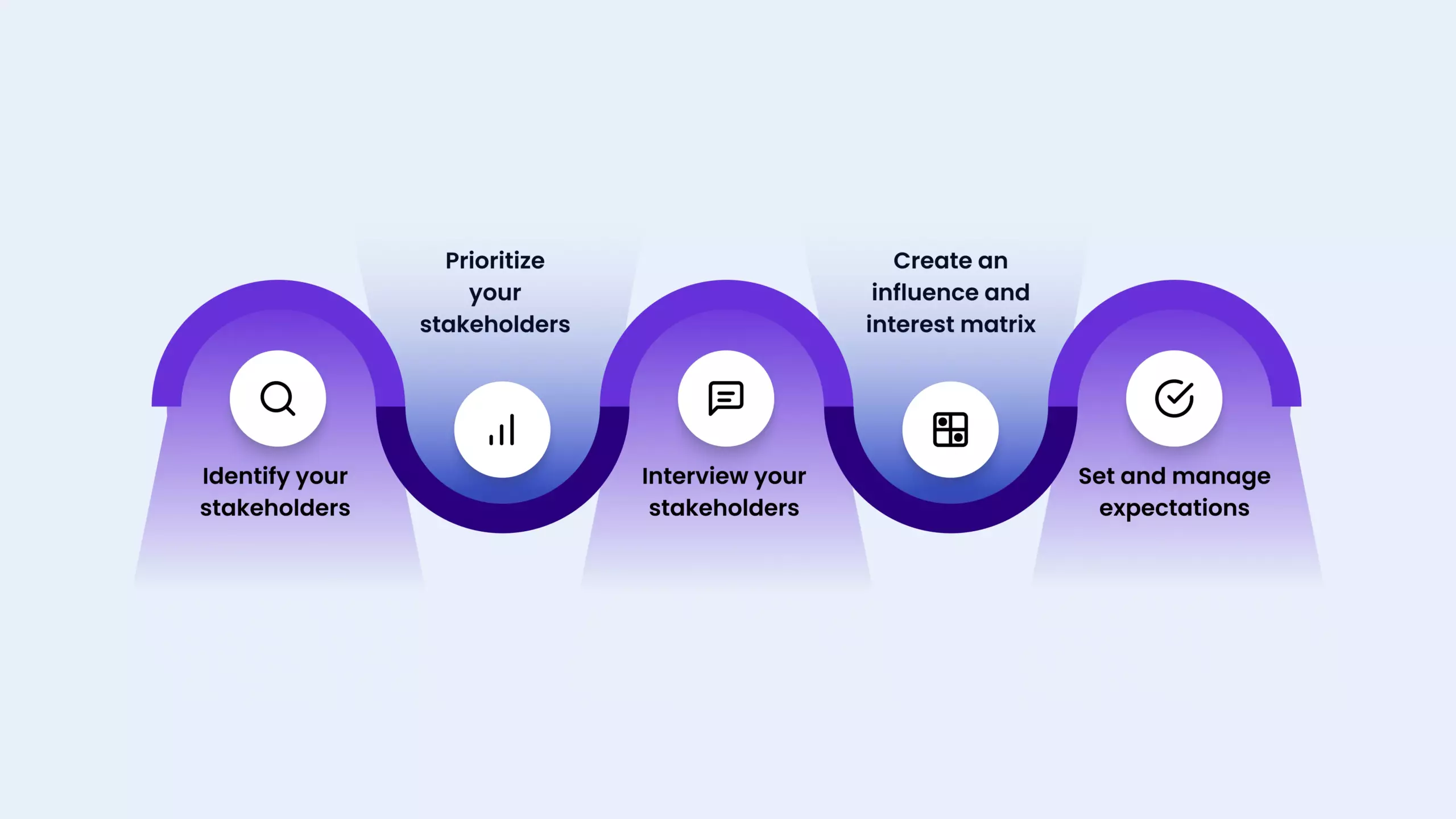
 In most projects, stakeholders can have the greatest influence on the direction of development in the early stages, when the scope of work is still flexible and decisions are easier to adjust. Later on, changes become expensive, and late feedback often leads to conflicts or delays. A practical stakeholder management strategy is to engage key stakeholders early on, agree on the definition of “success”, and set realistic expectations from day one.
 Effective stakeholder management begins with understanding who is important and why. Make a list of stakeholders (a registry), then rank them by level of influence and interest to focus your time on those who can change the outcome. An “influence-interest” matrix will help you decide who to work closely with, who to keep informed, and who to simply monitor.
 A stakeholder management plan should link analysis with action: who you will interact with, what topics are important to them, how you will communicate, and who on your side is responsible for each interaction. Good plans also define how to collect feedback and how to validate decisions so that interactions do not remain “pleasant conversations” without results.
 Best practice is not “more updates”. It is the right message, addressed to the right stakeholder at the right time, as well as genuine listening. Recommendations for stakeholder engagement often emphasize the need for early and frequent consultation, building trust, and recognizing that stakeholders are people (with their own concerns, emotions, and varying tolerances for risk).
 Stakeholders demand change when they feel uncertainty or risk, and this pressure can alter the scope and timing of work. Instead of reacting late, keep expectations in mind: what will happen, what will not happen, what “done” means, and what decisions need to be made (and by when). This reduces last-minute changes in scope and helps maintain predictability of execution.
 Stakeholder management is not a one-time workshop. Priorities change, new stakeholders emerge, and attitudes shift based on what people hear and feel. Make it a habit to review stakeholder status, update your plan, and record key interactions so your team doesn’t lose context and repeat old mistakes.
 Stakeholders influence each other: internal teams influence customer experience, customers influence revenue, revenue influences management pressure, and so on. Effective stakeholder management strategies balance outcomes and avoid optimizing for one group while inadvertently creating conflicts in others.In software delivery, stakeholder problems rarely show up as “relationship issues.” They usually appear as delayed approvals, repeated meetings, conflicting assumptions, last-minute scope changes, or work that has to be redone after late feedback.