

Why is the
dedicated development team
model such a thing in 2026? Because as AI accelerates software development, the bar for engineers keeps rising.
Those engineers are scarce, expensive, and not every company can hire them in-house. According to McKinsey’s Tech Talent Roundtable, only 16% of executives feel confident they have the technology talent needed to drive their digital transformation, and demand is expected to keep outpacing supply for the foreseeable future.
This trend is further supported by market data. The U.S. Bureau of Labor Statistics predicts that from 2024 to 2034, employment of software developers, QA analysts, & testers will grow by 15%. While Indeed Hiring Lab reports that requirements for candidates in tech jobs are becoming higher: the share of job openings requiring 5+ years of experience will increase between 2022 and 2026.
At the same time, the Deloitte 2024 Global Outsourcing Survey found that 80% of executives plan to maintain or increase investment in third-party outsourcing – a clear signal that companies are no longer treating external teams as a backup plan, but as a core part of their delivery strategy.
Can your business afford sums like that? Can you actually find those experienced, seasoned professionals in your area? And once you do, can you count on their
full-time commitment
?
If the answer to any of those questions is “no,” a dedicated development team model may be the right answer. Keep reading to see exactly when companies hire dedicated development team specialists, what it costs, and how to set it up step by step.
What are the benefits of dedicated teams?
When you hire a dedicated development team, you usually get a different working model than you would with traditional outsourcing.
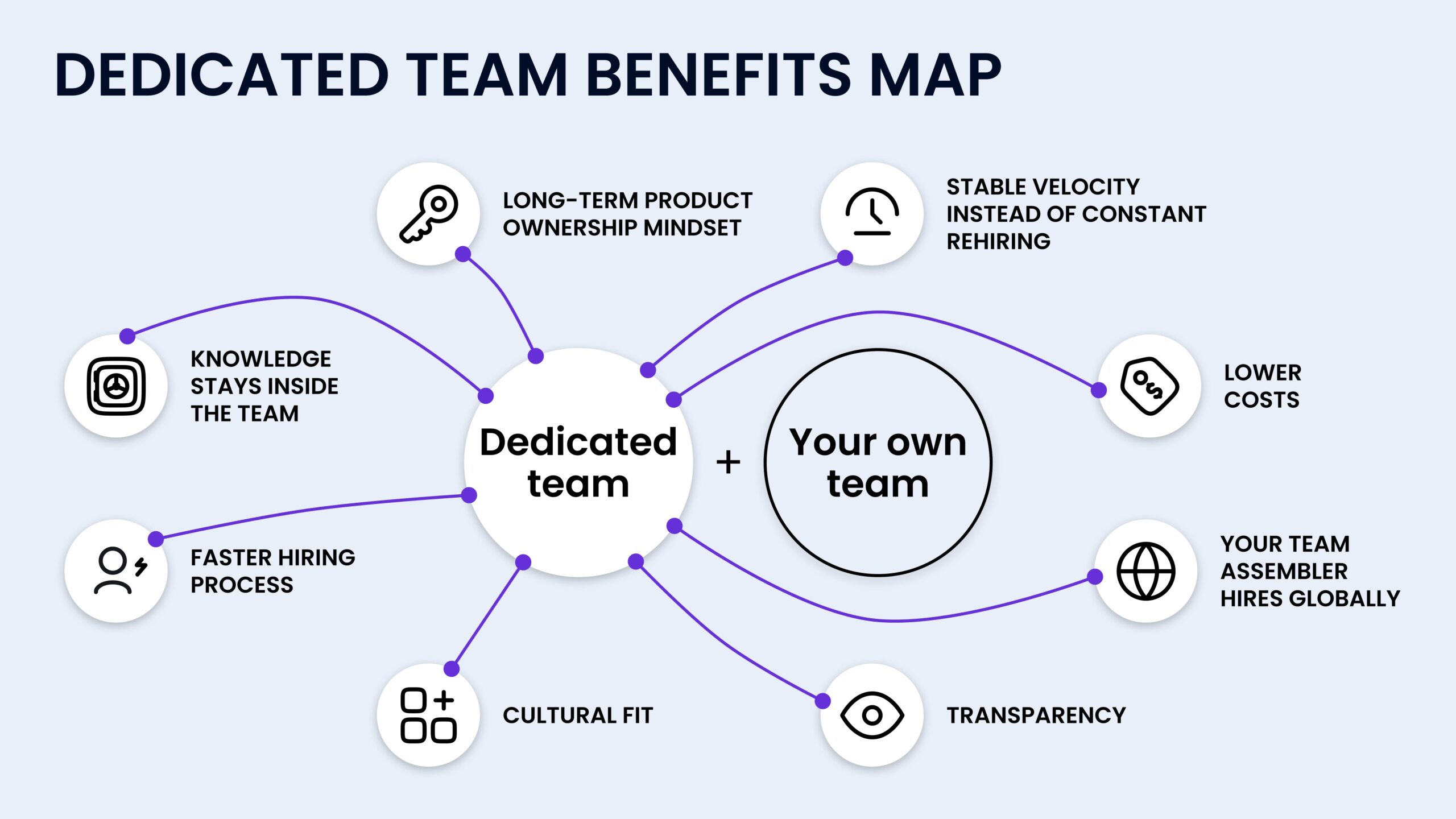
Instead of being “someone else’s developers,” the team becomes an extension of your own. You get real transparency into the work, a better cultural fit with the people building your product, and shared goals that go beyond simply closing tickets.
Rather than managing an external vendor, you build a
long-term collaboration
with a team that grows alongside your roadmap.
This matters because software delivery effectiveness improves when teams work in a stable environment, with minimal handoff friction and clear working procedures. DORA continues to use order fulfillment time, deployment frequency, change failure rate, and recovery time as key indicators of software delivery performance. And these metrics are harder to improve in the context of unstable, constantly changing team compositions.
The 2024 Accelerate State of DevOps Report by Google’s DORA team reinforces this point: stable priorities and well-defined team boundaries are among the strongest predictors of software delivery performance, while frequent reshuffling of people and goals significantly increases burnout and lowers throughput. In other words, a stable, dedicated team isn’t just a hiring convenience, it’s a measurable performance advantage.
What else do you get?
- Long-term product ownership mindset. With shared goals in place, developers focus on stability, scalability, and user impact instead of just finishing the next task.
- Stable velocity instead of constant rehiring. You avoid the productivity drops that come from replacing freelancers or rebuilding knowledge every few months.
- Knowledge stays inside the team. Architecture decisions, product history, and technical context accumulate rather than disappear when a contractor leaves.
But that’s not all.
Two of the biggest reasons companies choose to hire dedicated development teams are simple: lower costs and a faster hiring process.
And both come from the same core advantage – your team assembler hires globally. Instead of being stuck with the talent and salary levels in your own region, they recruit across multiple countries, giving you a much larger hiring pool and far more flexible compensation options.
Best regions to hire a dedicated development team in 2026
Below are the most popular tech hiring destinations for your business. We selected these countries based on their engineers’ English proficiency and technical expertise, the size of their software development sectors, government support for the IT industry, and average salary levels. Just pure numbers and facts to help you choose the best-fitting country to
hire a dedicated remote development team.
For broader market context, the global IT outsourcing market is projected to reach roughly $591 billion in 2025, with Eastern Europe, Latin America, and South/Southeast Asia continuing to absorb the bulk of dedicated team demand. The regional comparison below reflects where companies most often look when they hire dedicated development team specialists today.
Ukraine
Ukraine remains a major exporter of IT services, even under extreme conditions. In Jan–Jun 2025, the IT Ukraine Association reported robotics/software services exports of $3.210B.
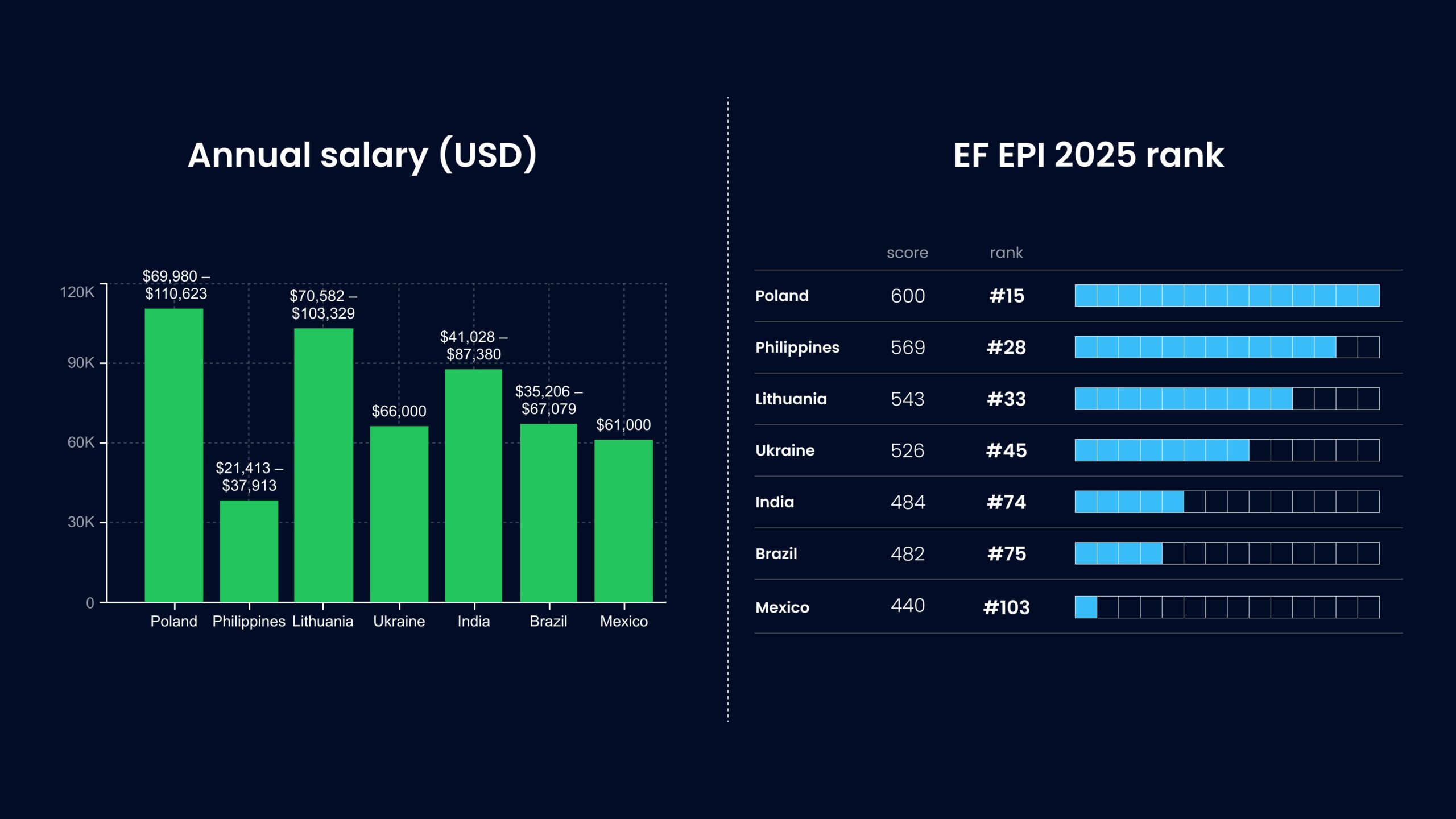
- According to salary data aggregated on Levels.fyi, a senior software engineer in Kyiv earns roughly $66,000 per year – well below comparable US metro rates for the same seniority.
- According to the EF English Proficiency Index 2025, Ukraine scores 526, ranked #45 globally.
- There’s also government support for tech and IT companies: there’s a special legal/tax regime aimed at stimulating the digital economy.
Best for: product teams that need strong engineering ownership and long-term continuity, but cannot price everything at US metro rates.
Poland
Why it’s a magnet: Poland is consistently described
as the largest IT talent pool in CEE, with estimates like 600,000+ IT specialists in market overviews.
- Salary reality: in Warsaw, a senior software engineer will get $69,980–$110,623 a year according to Levels.fyi.
- EF EPI 2025: Poland scores 600, ranked #15, “Very high proficiency.”
Best for: teams where you want “Western-style” work culture, strong English, and a big hiring market, without going full US pricing.
Lithuania
Why it punches above its size: Lithuania positions itself as a
serious tech and fintech hub, backed by the official ecosystem reporting.
- In Vilnius, a senior software engineer earns $70,582–$103,329 annually.
- EF EPI 2025: Lithuania scores 543, ranked #33 globally (EF).
Best for: smaller teams in backend, fintech, or product engineering, who want EU stability and strong communication.
Mexico
Mexico is best for US-based teams that value same-day collaboration and nearshore overlap more than “perfect English everywhere.”
- A senior software developer in Greater Mexico City has a median salary of around $61,000.
- EF EPI 2025: Mexico scores 440, ranked #103.
Brazil
In Brazil, you will get a strong engineering value per dollar, especially if you can run delivery in English inside your own management layer.
- A senior software developer in São Paulo gets $35,206–$67,079 a year.
- EF EPI 2025: Brazil scores 482, ranked #75.
Philippines
The country is best for cost-sensitive teams that need strong English and service-process maturity.
This positioning is also consistent with industry reporting from IBPAP, the main Philippine IT-BPM industry body, which continues to highlight the scale and growth of the sector.
- A senior software developer in Manila will get $21,413–$37,913 a year.
- EF EPI 2025: Philippines score 569, ranked #28.
India
India is always in the conversation when it comes to
dedicated development team services
. Here, you can hire “solid senior” or “world-class senior,” quite on a budget.
- A senior software developer in a large city like Bengaluru will get $41,028–$87,380 a year.
- EF EPI 2025: India scores 484, ranked #74.
- High government support: India’s Software Technology Parks (STP) of India describes the STP Scheme as a 100% export-oriented scheme for development and export of software and related professional services.
Best for: companies that want to hire dedicated development team specialists at scale, build multi-squad capability, or staff specialized engineering roles – provided they invest in strong technical leadership and consistent evaluation to manage variance.
How to hire a dedicated software development team step-by-step
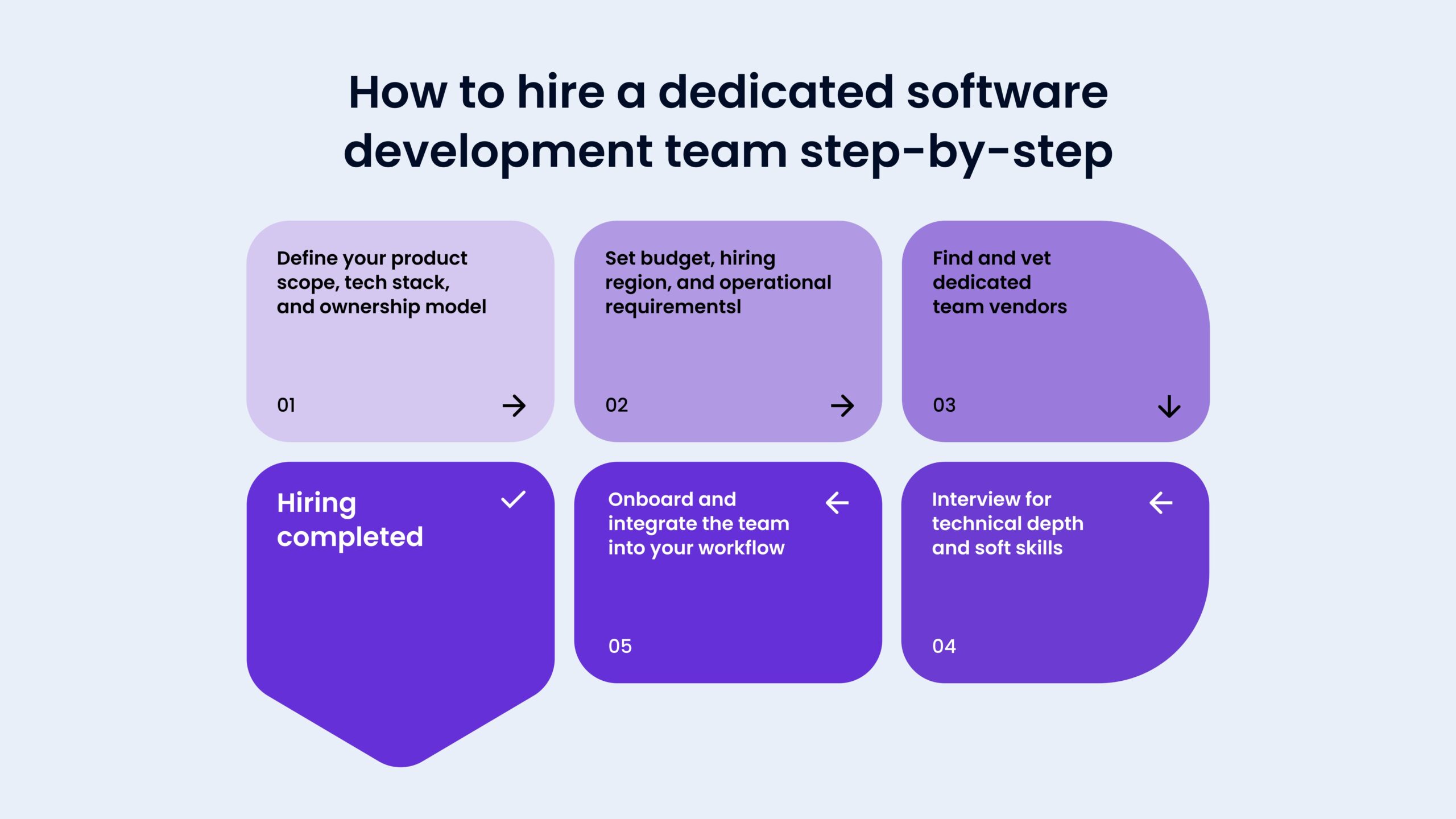
If you want to hire dedicated development team specialists, treat it as a sequence of setup steps that will shape how efficiently your project moves forward.
The guide below breaks the process into the same stages companies use in real hiring scenarios. Follow them to avoid the common mistakes that can slow you down.
In today’s market, this structure is even more important. According to Indeed Hiring Lab, employers are increasingly seeking experienced professionals, which leads to higher costs if job responsibilities are not clearly defined and candidate selection is inefficient. In practice, companies that hire dedicated development team specialists without locking these 5 steps in place tend to lose 2-4 weeks of the first sprint to setup chaos, missed approvals, and unclear ownership – a cost that compounds across the project lifecycle.
Step 1: Define your product scope, tech stack, and ownership model
Before talking to vendors, lock down the fundamentals of what you’re building and who makes technical decisions once development starts.
| Area | What you must define | Why it matters in practice |
|---|---|---|
| Product scope | Core features, expected launch version, approximate timeline | Vendors size the team incorrectly if the scope is vague |
| Tech stack | Backend, frontend, cloud preferences, database type if known | Prevents vendors from proposing teams built around the wrong technologies |
| Ownership model | Who controls architecture, backlog priorities, and technical approvals | Undefined ownership leads to delays and constant re-approval loops |
Step 2: Set budget, hiring region, and operational requirements
This step converts product plans into real hiring constraints.
| Area | What you must define | Why it matters in practice |
|---|---|---|
| Monthly team budget | Realistic spend per developer, not annual salary assumptions | Dedicated teams are priced monthly and not as internal hires |
| Hiring geography | Preferred regions, timezone overlap, English requirements | Prevents evaluating vendors that cannot meet your workflow needs |
| Workflow rules | Required working-hour overlap, sprint cadence, and documentation expectations | Avoids friction once development actually begins |
Step 3: Find and vet dedicated team vendors
Vendor evaluation should focus on delivery capability instead of marketing materials.
| Area | What to check | Why it matters in practice |
|---|---|---|
| Recruitment pipeline | Average hiring time, candidate pool size, and replacement guarantees | Slow hiring or weak replacement policies delay product releases |
| Delivery structure | Whether developers work exclusively on your project, and how HR/performance is handled | Shared engineers or unclear management reduce accountability |
| Transparency signals | Sprint reporting examples, onboarding timelines, real client references | Mature vendors can demonstrate processes and not just promise them |
Step 4: Interview for technical depth and soft skills
Even with a vendor, you must validate how engineers think and communicate.
| Focus | What to evaluate | Why it matters in practice |
|---|---|---|
| Technical decision-making | Ask candidates to explain real production challenges they solved | Shows whether they understand architecture beyond writing code |
| Problem-solving approach | Have them describe debugging or scaling incidents | Reveals how they operate under real system pressure |
| Communication clarity | Check how they explain tradeoffs and unclear requirements | Dedicated teams fail more from communication issues than coding issues |
Step 5: Onboard and integrate the team into your workflow
If onboarding is structured, teams usually reach stable productivity within the first month.
| Area | What must be set up early | Why it matters in practice |
|---|---|---|
| Technical access | Repositories, environments, documentation, coding standards | Without this, first sprints turn into setup chaos |
| Communication rhythm | Sprint planning, standups, demo schedule, escalation path | Establishes a predictable delivery cadence immediately |
| Decision authority | One internal owner is responsible for approvals | Multiple approval chains slow development dramatically |

Managing your remote dedicated team for success
When companies hire dedicated development team specialists, success depends less on constant supervision and more on having the right structure in place.
Success usually comes down to clear decision authority, predictable delivery flow, and making sure knowledge and priorities don’t get lost as the project grows.
In practice, this means putting a few core management rules in place.
Give the team a real technical decision-maker
Someone with
CTO-level oversight
must approve architecture choices, review major technical risks, and resolve disputes quickly. This role doesn’t manage tickets but protects long-term system health and prevents short-term shortcuts from turning into expensive rebuilds.
Run development through a visible delivery process
Your team should follow a consistent
SDLC (Software Development Life Cycle)
with requirements clarified before coding, mandatory code reviews, testing before release, and a predictable deployment rhythm. This removes guesswork and keeps remote work from turning chaotic.
Make scaling the team operationally easy
Growth should not slow delivery. If adding one developer causes weeks of setup, missing documentation, or broken environments, your management setup isn’t scalable. Strong teams keep onboarding guides, environment scripts, and architecture rules ready so new engineers can contribute fast.
Don’t let knowledge live in people’s heads
Continuous
knowledge transfer
is essential. Architecture decisions, integrations, and deployment steps should be documented as they evolve. Regular demos and shared technical notes prevent the project from depending on any single developer.
Keep daily work tied to the bigger plan
Developers shouldn’t see only sprint tickets – they should understand the
project roadmap
. Knowing what features, integrations, or scaling events are coming changes how engineers design solutions today and helps avoid rework later.
When companies hire dedicated development team specialists and put these basics in place early, remote teams usually run much more smoothly.
When they aren’t, even very strong engineers struggle to keep delivery stable.
This is consistent with what the 2024 DORA report calls the strongest organizational predictors of software delivery performance: stable priorities, clear team boundaries, transformational leadership, and high-quality documentation. Teams that miss these basics rarely reach elite performance (defined in the report as deploying multiple times per day with a change failure rate of 5% or lower) regardless of how senior the individual engineers are.
As MWDN Managing Partner Vitalii Vystavnyi puts it: “Businesses don’t just need people who can ‘vibe-code,’ they need senior specialists who can design, scale, and maintain real systems.” That’s exactly the gap most companies face when they hire dedicated development team specialists today. The AI tooling raises the floor, but only experienced engineers raise the ceiling.
Dedicated team vs staff augmentation: Which is right for you?
When companies plan to hire dedicated development team specialists, they often compare this model with another popular approach: staff augmentation.
What’s the practical difference between the two?
In practice, the choice usually depends on management capabilities and the maturity level of operational activities. The more the implementation process relies on documented workflows, a shared understanding of the context, and a clear division of responsibilities, the more suitable the specialized team model is compared to bringing in individual specialists one by one.
Take a look at the table below to find out.
| Dedicated team | Staff augmentation | |
|---|---|---|
| What it is | A full external team assembled to work long-term on your product | Individual developers added to your existing internal team |
| Best for | Building or scaling a full product, long-term roadmap, and continuous delivery | Filling skill gaps, boosting capacity, short-, mid-, or long-term needs |
| Management responsibility | Shared: vendor handles HR/admin, you guide product direction | Mostly yours: augmented developers integrate into your internal processes |
| Team structure | Pre-formed team with developers, QA, and sometimes PM or DevOps | Individual specialists plugged into your existing structure |
| Speed of hiring | Moderate: vendor assembles a balanced team based on requirements | Usually faster for single roles or urgent replacements |
| Scalability | Easy to expand into a larger autonomous team over time | Scaling means hiring more individuals and managing integration |
| Product ownership mindset | Teams usually stay long-term and accumulate domain knowledge | Individuals often focus on assigned tasks rather than long-term product strategy |
| Knowledge retention | Higher, because the team stays stable and documentation flows within the group | Depends heavily on your internal processes |
| Typical cost structure | Monthly rate per team member, predictable long-term budgeting | Hourly or monthly per specialist, very flexible |
| When it usually fails | When product ownership or priorities are unclear | When internal management bandwidth is insufficient |
The cost gap is the clearest argument for going global. According to Levels.fyi compensation data, a senior software engineer in Tel Aviv typically earns $100K+ per year, while in New York City total compensation for the same seniority commonly exceeds $170K. Compare that to the regional benchmarks above and the math behind the dedicated team model becomes obvious: for the cost of one US-metro senior, you can often staff a full small squad in CEE, LatAm, or Asia.
Many software vendors, including MWDN, operate across both models at the same time and can adjust the cooperation format as the project evolves. If you’re trying to decide which one fits your situation, the fastest path is usually to schedule a short consultation and get a hiring estimate based on your scope, timeline, and target region. That way you can compare a dedicated team setup and a staff augmentation setup side by side before committing.
FAQ: Everything you need to know about dedicated teams
Still wondering how the dedicated development team model works? Below are some of the most common questions, with short and clear answers.
What is a dedicated development team, and how does it work?
A dedicated development team is a group of developers hired to work exclusively on your project long-term. They integrate into your workflow, follow your priorities, and handle ongoing development while the vendor manages hiring, payroll, and administration.
When should a company choose a dedicated team instead of hiring in-house developers?
Choose a dedicated team when you need long-term development capacity but want to hire faster, scale more flexibly, or access global talent without building an internal department. It’s most suitable for ongoing products, tight hiring timelines, or when local senior engineers are too expensive or hard to find.
How to choose a dedicated development team?
Choose a dedicated development team by evaluating delivery capability first. Review how quickly the vendor hires senior engineers, how they handle replacements, whether developers are assigned exclusively to your project, and how transparent their reporting and communication processes are. Strong vendors provide clear onboarding plans, retention metrics, and client references, along with proven project experience.
How to build a remote software dedicated team from scratch?
Build a remote software dedicated team from scratch by following a simple sequence: define your product scope and tech stack, set a realistic budget and hiring region, choose and vet a reliable vendor, interview the engineers yourself, and onboard the team into your workflow with clear ownership, communication rules, and a shared roadmap.
Is a dedicated software team cost-effective?
Yes, a dedicated software team is usually cost-effective for long-term development because it reduces hiring time, avoids internal HR and infrastructure costs, and lets you access senior engineers in global markets where salaries are lower. The model works best when the project runs for months or years; for very short tasks, the setup overhead may outweigh the savings.
How much does it cost to hire a dedicated development team?
The cost of a dedicated development team depends mainly on the number of specialists, their seniority, and the hiring region. In practice, companies typically pay a monthly rate per developer, often ranging from $4,000 to $12,000+, depending on location and experience. The total team budget is simply the sum of those monthly rates.
How long does it take to assemble a dedicated development team?
It typically takes 2–6 weeks. Initial candidates are often presented within the first 1–2 weeks, and the remaining time covers interviews, approvals, and onboarding. Larger or highly specialized teams may take longer to complete.
Who manages the developers in a dedicated team – the client or the vendor?
Both. In a dedicated team model, the client manages the product direction, priorities, and daily tasks, while the vendor handles HR, payroll, hiring, and administrative support. This keeps technical control with you while the operational management stays with the provider.
How do companies ensure quality control when working with a remote dedicated team?
Companies ensure quality control in a remote dedicated team by setting clear development standards, enforcing code reviews and testing within the SDLC, and tracking progress through regular demos and sprint checkpoints. Keeping a technical lead or CTO-level reviewer involved in architecture decisions also helps catch risks early and maintain consistent engineering quality.
What are the biggest risks when hiring a dedicated development team, and how can they be avoided?
The biggest risks when hiring a dedicated development team are unclear ownership, weak communication, and knowledge being locked inside individual developers. These can be avoided by assigning a clear technical decision-maker, establishing a structured development process with regular reviews and demos, and documenting architecture and workflows continuously so the project stays stable even if team members change.